
25th Sunday after Pentecost
(6th after Epiphany transferred)
Most of us spend a substantial part of our lives fretting about the past and the future. It’s almost as if we really thought that everything, even in the order of grace, depends on us, and if we don’t sort things out for ourselves and make ourselves holy, our lives will be one great failure. This is nothing short of a practical form of atheism. In theory we believe in God and in His providence, but when it comes down to actual day-to-day events, we somehow seem to have drifted into the class of the agnostic. In our partial defence, the action of Divine Providence is, most of the time, hidden from our eyes. It’s only when God’s work reaches its completion – or when He mercifully shows us the fruits of our labours even for a brief moment – that it dawns on us that something was happening all along behind the scenes.
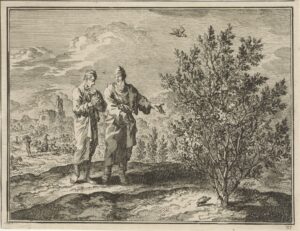
This is the deeper meaning of today’s Gospel in which Our Lord uses two parables to convey the same message. The first is the tiny grain of mustard seed that is so very small as to make us believe that the plant it produces will also go unnoticed. In fact, it grows into an impressive garden plant that resembles a small tree. The second is the yeast that is worked into the dough, and that will cause it to rise and produce a beautiful, tasty loaf of bread. The same thought inspires both these realities, and it is this: God’s action is, most of the time, hidden from our eyes. No one sees the mustard seed sprout. No one monitors its growth. Only gradually does it surprise us by its size. No one sees the leaven at work in the dough, and yet it certainly makes it rise. If you don’t think it does, next time you make bread, leave it out, and you’ll see!
One is reminded of this other parable that Our Blessed Lord gave us: “The kingdom of God is as if a man should scatter seed upon the ground, and should sleep and rise night and day, and the seed should sprout and grow, he knows not how. The earth produces of itself, first the blade, then the ear, then the full grain in the ear. But when the grain is ripe, at once he puts in the sickle, because the harvest has come” (Mk 4:26-29).
The grain sprouts, the plant grows, the fruit is formed, we know not how. The life of grace grows in our hearts; we find ourselves avoiding occasions of sin and practising virtue; we know not how. All we need to do is believe and trust and cooperate with that grace by performing actions that often seem so insignificant, such as a short prayer or a small sacrifice of our leisure or pleasure – just as insignificant as a grain of mustard seed or a bit of leaven! –and yet the growth is real and one day manifests itself to us and to the world without any doubt whatsoever.
In the Spiritual Exercises, St Ignatius of Loyola refers to the miraculous manifestation of the holy Resurrection “in its true and most sacred effects” (Sp. Ex. 223). And yet, when we read the Gospels, the manifestation of the Resurrection seems to be rather unspectacular, even low-key. He does not burst forth from the tomb with a flash of light seen around Jerusalem, nor does He appear in glory on the pinnacle of the temple. It’s only gradually that the apostles themselves will come to realise what has happened, and even more gradually that the word will spread throughout the world and souls will be converted. Two thousand years later, those true and most sacred effects are still on display, because the source was one of infinite power. Although condensed in an event hidden behind the stone walls of a grave that no one witnessed, it has transformed human history from the inside ever since, because it contained infinite power, infinite love, that no amount of time and no amount of persecution can ever diminish or slow down. Very much like the mustard seed, the Resurrection has grown to spread Christianity around the world.
What consequences can we draw from all this? There are, of course, many, but I will propose just one today, perhaps the most important one. It is inspired by the example of a saint that we commemorated last Sunday, namely Elizabeth of the Trinity. At a very young age, Elizabeth understood the essentials of the spiritual life. She knew that a tiny grain had been sown in her pure soul on the day of her baptism, a seed that gradually grew to the point of taking complete control of her existence. The indwelling of the Triune God became her constant focus. Nothing else held any sway over her mind and heart. She was so solidly anchored in the reality of the Divine that her life passed in the deepest peace, even though numerous events could very well have caused her to lose that peace, and terrifying sufferings would lead her to a premature death.
Elizabeth’s secret, like that of many other saints, canonised and not, is that we are not called to live on the surface of created realities. We are called to something much deeper: to allow ourselves to be drawn ever more into the world of the inside, the wonders of the interior life. We are meant to ponder, more and more as our life flows inexorably towards its denouement, that grain of mustard seed called divine grace, that is given to grow, slowly but unendingly, leading us ultimately to produce some magnificent fruit, even in this life, until finally the fruit is garnered into the eternal kingdom.
St Elizabeth of the Trinity taught us to pray: “O my God, Trinity Whom I adore! help me to become utterly forgetful of self, that I may establish myself in Thee, as changeless and as calm as though my soul were already in eternity. May nothing disturb my peace nor draw me forth from Thee, O my immutable Lord! but may I penetrate more deeply every moment into the depths of Thy Mystery. Give peace to my soul; make it Thy Heaven, Thy cherished dwelling, Thy home of rest. May I never leave Thee there alone, but be wholly present, my faith wholly vigilant, wholly adoring and wholly surrendered to Thy creative action”.
As this marvellous prayer expresses, the constant focus on God in our hearts has this tremendous advantage: it allows our soul to never really be disturbed or even disquieted. In this St Elizabeth was only emulating the great Madre, St Teresa of Avila, who reminds us in a famous passage:
Let nothing disturb you,
Let nothing affright you,
All things are passing.
God does not change.
Patience obtains all things.
When one has God,
Nothing is lacking:
God alone suffices.
Both these saints really were only paraphrasing what the psalmist had already sung millennia before: O how abundant is Thy goodness, which Thou hast laid up for those who fear Thee… In the covert of Thy presence Thou hidest them… Thou holdest them safe under Thy shelter (Psalm 30:19-20).
Yes, Divine Providence holds in the covert of His presence, under the shelter of His protection, those who truly make efforts to pull their minds back from the distractions of multiple objects, to turn the gaze of their heart to the indwelling of the Trinity in their souls, who seek refuge from the noisy world, in the calm and tranquillity of the ever-tranquil Trinity.
Let us have confidence and never forget: even though we do not see it and may not feel it, the seed is growing, the dough is rising, the sacred effects of the glory of God are spreading. One day, the veil will be rent, the majesty of the Beloved will be revealed, and those who truly and perseveringly sought Him in the darkness of this fleeting existence will be inundated with eternal peace and an exuberant joy surpassing our wildest dreams.