
7th Sunday after Pentecost
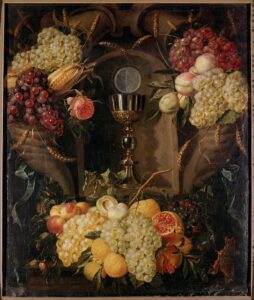
By their fruits you shall know them. This well-known verse deserves all our attention. It can easily be used to discredit persons or groups who do not, at least on the surface, seem to be producing good fruit, or at least not as much as others. If we understand it that way, we’re off to a bad start, for the Lord’s intention was not to promote unhealthy rivalry or bias between groups or communities, such as one can easily hear in certain places: ‘we have more vocations, or we have more children in our schools, or we have more converts, or we have more money, or we have bigger churches, etc, than those other people, so we must be good and they must be, if not bad, well at least, not so good as us’. Such an attitude obviously smacks of the pharisaical, and it forgets two very important factors. The first is that there can be numerous other reasons that contribute to material fruits or to a lack thereof. It is therefore not possible to reject some as being unprofitable just because their fruits do not necessarily appear on the surface.
Secondly and more importantly, for anyone familiar with the New Testament, it is obvious that the fruits that all of us should be striving to produce are not those of material success (and numbers of converts and sizes of churches are certainly material considerations). Indeed, it is one of the themes of the New Testament that holiness does not consist in a show of good works. Unlike a certain mentality that is common among some misguided Christians, the promise of earthly prosperity given of old to the Hebrews is certainly not, at least in the New Testament, a sign of God’s presence and blessing. It is simple-minded, and quite erroneous, to pretend that since we have a lot of money, or the best scholars or the nicest vestments or the best chant or the most generous parishioners, that we are especially blessed by God.
So how then are we to make sense of Our Blessed Lord’s words By their fruits you shall know them? Quite simply, we go to St Paul, who is the interpreter par excellence of Our Lord’s words. A first answer is given in today’s epistle in which the apostle reminds the Romans that when they lived like pagans they had nothing to show for it: they produced no fruit. But now that they are in God’s grace, they can produce the fruit of holy lives. Hear his words: For just as you once yielded your members to impurity and to greater and greater iniquity, so now yield your members to righteousness for sanctification. When you were slaves of sin, you were free in regard to righteousness. But then what fruit did you get from the things of which you are now ashamed? The end of those things is death. But now that you have been set free from sin and have become slaves of God, the fruit you reap is sanctification and its end, eternal life. For the wages of sin is death, but the free gift of God is eternal life in Christ Jesus our Lord (Rm 6:19-23). The conclusion should be obvious: the fruit that Our Lord wants to see us produce is a life of holiness, far removed from vice in all its forms. If we produce such fruit, it is stored up in Heaven as an everlasting treasure. But if we continue to practice vice while appearing on the outside to be a good person, then we are like the wolf in sheep’s clothing of which Our Lord speaks in today’s Gospel.
There is yet another, and in some ways, even more incisive text of St Paul that illustrates with the greatest clarity the good fruit that we are called to produce, and it is found interestingly enough in the epistle to the Galatians. This epistle, like that to the Romans, insists heavily on faith as opposed to the external observance of the Mosaic law. Towards the end of the epistle to the Galatians, St Paul compares the works of the flesh with the fruit of the Spirit: Now the works of the flesh are manifest: immorality, impurity, licentiousness, idolatry, sorcery, enmity, strife, jealousy, anger, selfishness, dissension, party spirit, envy, drunkenness, carousing, and the like. I warn you, as I warned you before, that those who do such things shall not inherit the kingdom of God (Gal 5:19-21).
After this sad enumeration of the works of the flesh, the apostle goes on: But the fruit of the Spirit is love, joy, peace, patience, kindness, goodness, faithfulness, gentleness, self-control; against such there is no law. And those who belong to Christ Jesus have crucified the flesh with its passions and desires. If we live by the Spirit, let us also walk by the Spirit. Let us have no self-conceit, no provoking of one another, no envy of one another (Gal 5:22-26).
We must conclude then, that when Our Blessed Lord says By their fruits you shall know them, He is referring to these fruits of life in the Spirit, and not in the flesh. As confirmation of this, we need only remember that there are plenty of examples of people who, to all appearances, lived good lives, only to be later found to be either crooks or profoundly immoral in other ways. Conversely, there is no lack of canonised saints who, to all appearances, were failures in this life. Like the Lord Himself, they were brushed aside as irrelevant by the religious intelligentsia of the day, but they were the ones who produced the fruits of the Spirit.
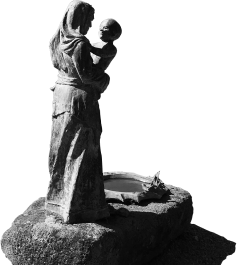
Let’s go once again to St Paul who tells us at the beginning of his first epistle to the Corinthians: Not many of you were wise according to worldly standards, not many were powerful, not many were of noble birth; but God chose what is foolish in the world to shame the wise, God chose what is weak in the world to shame the strong, God chose what is low and despised in the world, even things that are not, to bring to nothing things that are (1 Cor 1:26-28). We read this text this past Monday on the feast of St Maria Goretti. From a worldly perspective, her life was a waste. For refusing to commit a mortal sin – that most of our contemporaries would consider to be a few minutes of harmless fun –she died a cruel death. Where is the fruit of such a life? The fruit is the chastity that sets her apart and makes her a model for generations to come. God chose what is weak in the world to shame the strong.
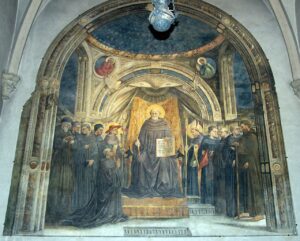
Another example we can point to is St John Gualbert, whose feast is celebrated today. Born into a noble family and given over to worldly vices and romantic intrigues, he set out to avenge the murder of his only brother. When, surrounded by armed followers, he chanced upon the assassin in a narrow Florentine street, he had the perfect opportunity to take his revenge. It was Good Friday, and the killer knelt with arms outstretched and begged for mercy in the name of Jesus. John remembered the words of Our Lord: Forgive and you will be forgiven (Lk 6:37), and he granted mercy to his enemy. Thereupon, he entered the Benedictine Church of San Miniato that overlooks Florence. He begged pardon for his sins and was thereafter clothed with the Benedictine habit and would go on to found the Congregation of the Vallombrosians. Such is the fruit that reveals the presence of the Holy Spirit at work in His saints.
Let us ask these two saints to intercede for us, that we may know how to put all our efforts, not into externals, producing ephemeral flowers that today are here and tomorrow fade, but rather into producing spiritual fruit that ripens through the practice of self-control and faithfulness in charity, in chastity, in patience, in gentleness. Then we will truly be known, not by a facade that makes us look good for a time, but by the fruits of the Spirit, which will truly make us good for eternity.