

5th Sunday after Pentecost
Today’s liturgy is entirely centred on the importance of fraternal charity and the necessity of forgiving each other’s offences. We all know the primordial place of charity in our faith. At the Last Supper, Our Blessed Lord made it clear that fraternal charity is the sign by which His disciples are recognised: Love one another as I have loved you. In this shall all men know that you are my disciples, if you have love for one another (Jn 13:34-35). If there is one distinctive trait that Christianity has brought to the world, it is indeed the importance of loving all men in Christ, first of all those who with us already share the true faith, and secondly those who are as yet outside the true fold, so that they may some day receive the grace of conversion.
Saint Augustine says, ‘Love alone puts the difference between the children of God and the children of the devil. Let them all sign themselves with the sign of the cross of Christ; let them all respond, Amen; let all sing Alleluia; let all be baptised, let all come to church, let all build the walls of churches: there is no discerning of the children of God from the children of the devil, but only by charity. They that have charity are born of God: they that have it not, are not born of God. A mighty token, a mighty distinction! Have what you will; if this alone you have not, it profits you nothing: other things if you have not, have this, and you have fulfilled the law. For he that loves another has fulfilled the law, says the apostle: and, Charity is the fulfilling of the law’ (Homilies on the First Epistle of St John, 5, 7).
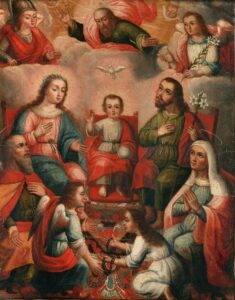
There is only one love. Love of God and love of neighbour are not two different entities. They are essentially the same, and they are mutually inclusive. To exclude one of them is to exclude the other. To exclude the brother or the sister or the child is to exclude God Himself from our life. Such is the sign that the Lord gives us and by which we must be conspicuous in the eyes of the world.
St Peter Favre, once of the first disciples of St Ignatius of Loyola, in the face of those Catholics who were so quick to condemn en masse all non-Catholics to hell, wrote to a fellow Jesuit who was asking for advice: ‘Remember, if we want to be of help to them, we must be careful to regard them with love, to love them in deed and in truth, and to banish from our souls anything that might lessen our love and esteem for them’. For the true Catholic, every person is a brother, either in fact or in hope. No one do we exclude from the circle of our prayers and good deeds.
St Peter Favre was only emulating another great champion of Catholic orthodoxy, St Gregory of Nazienzen, who, during the Christological battles of the fourth century, begged the people to be very slow to sever themselves from the Communion of those whom they thought to be erring brethren. In other words, to be very slow to slap the epithet ‘heretic’ or ‘schismatic’ on a brother in faith. If such a declaration needs to be made, it can only be made by the one who holds authority over the universal Church, and even then, it can only be with a desire to heal and bring to conversion.
Our Blessed Lord once said to St. Catherine of Genoa: ‘My child, those who love Me must also love what I love. Consequently, they must love their neighbour next to God, and must work heart and soul for his salvation… Love of their neighbour is an infallible sign of the love which creatures have for God, since God is the Creator, the Father and the Preserver of all men. It is by love of their neighbour that creatures prove their gratitude for the great love God bears them… Charity towards one’s neighbour is one of the most excellent virtues. It consists in wishing for him the same good that you wish for yourself; in giving up temporal interests for the salvation of his soul; in doing good to him without expecting any return, purely for the love of God.’ In the same vein, St John Bosco said that he could not believe in the salvation of anyone who never did anything for the salvation of his brother.
With all this in mind, we are in a better position to understand the lesson of today’s Gospel reading: If thou offer thy gift at the altar, and there thou remember that thy brother hath anything against thee; leave there thy offering before the altar, and go first to be reconciled to thy brother, and then coming thou shalt offer thy gift (Mt 5:23-24). Tonight at the Magnificat antiphon, this text is put to the most expressive chant as it depicts Our Lord raising His voice at the words: Leave thy offering before the altar, to then continue in a subdued tone go first to be reconciled to thy brother, as if to stress the unbecoming gesture of the Christian coming to the altar of God to make his offering, while being at odds with his own brother, and the required humility and meekness with which we must act. What does this mean? It means that God does not want our gift; He wants us, and if we are not able to forgive our brother or sister, whatever they may have done to offend us, in word or in deed, then we cannot offer ourselves to God, and therefore that gift we bring is useless. Note that the Lord did not say: If you have anything against your brother, for in that case, all you would need to do is forgive and move on. No, He said, If your brother has anything against you, rightly or wrongly.
Christianity is what built the civilisation of love. As our world distances itself from Christianity, it leaves aside fraternal charity, conflicts multiply, and others become our enemies. It is so very important for us to give the example of forgiving offences, even at great cost to ourselves, for as St Peter tells us in today’s epistle: Be ye all of one mind, having compassion one of another, being lovers of the brotherhood, merciful, modest, humble: not rendering evil for evil, nor insult for insult, but contrariwise, blessing: for unto this are you called, that you may inherit a blessing” (1 Pt 3:8-9). Not rendering evil for evil, but rather good. Render good for evil. If you are cursed, bless. If you are cheated and if no one else but yourself is going to be harmed by it, do not demand justice. Justice is a great virtue, but mercy surpasses justice and brings it to its perfection. But, St Peter adds, if also you suffer any thing for justice’ sake, blessed are ye. And be not afraid of their fear, and be not troubled. But sanctify the Lord Christ in your hearts, being ready always to satisfy every one that asketh you a reason of that hope which is in you (1 Pt 3:8-9).
It’s a beautiful program that cannot fail to inspire, but at the same time, it can make us tremble, for we know by experience how hard it sometimes is to show mercy when we want to demand justice and punishment. And this is why we are given the magnificent oration of this Sunday’s Mass in which we ask: O God, who hast prepared for those who love Thee such good things as eye hath not seen; pour into our hearts such love towards Thee, that loving Thee above all things, we may obtain Thy promises which exceed all that one can desire. God does not desire to give us any created reward, no lovely creature to captivate our itching for joy and pleasure. No, He desires to give Himself, who alone surpasses all that we can desire. But to be worthy of that ineffable gift, we have to become God-like, we have to imitate God, the only God, God Incarnate who walked this earth of ours, going about doing good, reconciling sinners and paying Himself the price that was theirs.

We will never remind ourselves too frequently of the fact that Christianity is not a human attempt to do something pleasing to God. It is God Himself who steps into our history to show us the path that leads to Him. Is it any surprise that His ways startle us, jolting us out of our entrenched habits and mindset? Let’s let ourselves be tamed by the example of the Lord. Let’s learn how to turn the other cheek. Let’s make our community one in which love for each other is so conspicuous that, like the early pagans, the people around us will look at us stupefied and say: ‘Look how they love one another’. If we are focused more on external points of observance than on true love of neighbour, we run the risk of falling under the same condemnation of the Pharisees referred to at the beginning of today’s Gospel: Unless your justice abound more than that of the scribes and Pharisees, you shall not enter into the kingdom of heaven (Mt 5:20).
The old apostle St John, whenever asked to teach the brethren, would simply repeat: ‘My little children, love one another’. When the disciples asked him why he always said the same thing over and over again, his only reply was: ‘Because it is the command of the Lord. If only it is done, it is enough’. Si solum fiat, sufficit. If only it is done. If only we could get out of our little tower of ivory and open up to the needs of our neighbour, that would be enough. How is it enough? It is enough because there is only one love. If you love the neighbour you can see, you love the God you cannot see. God makes Himself visible in that brother, in that sister, in that child, born or unborn, whatever their failings, whatever their weakness, whatever cross they might be to us at the present moment.
What you did to the least of my brethren, you did to me (Mt 25:40).
If I your Lord and Master have washed your feet, so you should wash one another’s feet (Jn 13:14).
In this will all men know that you are my disciples: if you have love for one another (Jn 13:34-35).