
24th Sunday after Pentecost
(5th after Epiphany transferred)
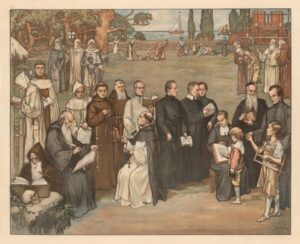
In perfect continuity with our reflections last week for the feast of All Saints, St Paul, in today’s epistle, lays out a magnificent program for what it means to be a true Christian. To fully understand it, however, we need to situate it in the context of the third chapter of the epistle to the Colossians.
The apostle begins by stating that the new life we have in Christ stems directly from the Lord’s resurrection: If you have been raised with Christ, seek the things that are above, where Christ is, seated at the right hand of God. Set your minds on things that are above, not on things that are on earth. (Col 3:1-3). To be in Christ, in other words, means to be living a new life, like that of the Risen Saviour. And this has consequences.
The first of these is that there are a number of things that pagans do that Christians do not do. Paul goes straight to the point: Put to death therefore what is earthly in you: immorality, impurity, passion, evil desire, and covetousness, which is idolatry (Col 3:5). To the Ephesians he will go even further and say that such things should not even be mentioned among you (cf. Eph 5:3). The import of this is that there are some things that are so diametrically opposed to the life of grace that it is obvious that there is no place for them in our lives. Christ has risen from the dead to lift us up with Him to Heaven, so we cannot indulge in what pulls us down to the level of corruptible flesh.
But that is not enough. Acknowledging the potential danger that could accrue to someone who lives an impeccable life in terms of sexual morality, he adds now: put them all away: anger, wrath, malice, slander, and foul talk from your mouth. Do not lie to one another (Col 3:8-9). One of the grave temptations of those who have truly found Christ is to be intolerant with others, to give way to temptations of pride which sometimes manifest themselves in the way people speak and act toward one another. This is a real danger that we must be wary of. It was a topic that the early Fathers frequently returned to in their writings to the women who had consecrated their lives to God in holy virginity. It can happen to the best of people and in the best of communities, especially those that pride themselves on the impeccability of their worship, their manners or their attire. There can be a certain self-sufficiency that causes one to look down on others as if they did not exist or deserve our respect.
St James had already noted the unchristian ways some of the early Christians had towards newcomers: If a man with gold rings and in fine clothing comes into your assembly, and a poor man in shabby clothing also comes in, and you pay attention to the one who wears the fine clothing and say, “Have a seat here, please,” while you say to the poor man, “Stand there,” or, “Sit at my feet,” have you not made distinctions among yourselves, and become judges with evil thoughts? (James 2:2-4).
This is precisely why Paul goes on to paint the picture of the true Christian in the passage we have in today’s epistle: Put on then, as God’s chosen ones, holy and beloved, compassion, kindness, lowliness, meekness, and patience, forbearing one another and, if one has a complaint against another, forgiving each other; as the Lord has forgiven you, so you also must forgive.
In such a community, peace and love reign supreme. Anyone in need finds it. Those who were lost are found. No one feels superior to anyone else, for each looks upon the other as a brother or sister for whom Christ shed His blood. And if a newcomer presents himself, he is welcomed in a spirit of fraternity that makes him feel at home, a home in which souls are saved, and God is glorified. And above all these put on love, which binds everything together in perfect harmony. And let the peace of Christ rule in your hearts, to which indeed you were called in the one body. And be thankful. Let the word of Christ dwell in you richly, as you teach and admonish one another in all wisdom, and as you sing psalms and hymns and spiritual songs with thankfulness in your hearts to God. And whatever you do, in word or deed, do everything in the name of the Lord Jesus, giving thanks to God the Father through him (Col 3:12-17).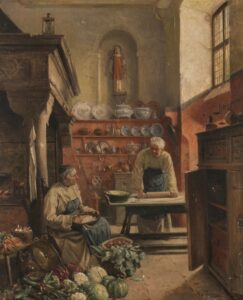
When such peace is established, however, the work is not over. The enemy will do all in his power to disrupt it, as the lesson of today’s Gospel shows us. The Lord, indeed, sows the good seed in His Church. He gives us the pure teaching of the Gospel and the excellent models to follow in the lives of the saints. But the devil comes and sows his own seed, the seed of pride, ambition, discord, and envy, those evil seeds that can disrupt and overthrow any community that does not take care to contemplate and base its life on the teachings and examples of our Blessed Lord.
The spirit of the world is always lurking in a corner, ready to pounce upon us and take away the peace of our hearts and of our community. That evil spirit is always there and ever will be until the end of time. The wheat grows together with the weeds. Every Christian community has its weeds. God leaves them there in order to put to the test His faithful ones, to incite them to remain strong, to not grow weak, to persevere in endurance and patience, to thrive in the practice of fraternal charity and mutual forbearance. Otherwise we would not have an opportunity to prove our love for Him.
One day soon, at the end of time, Almighty God will send His angels to reap the harvest, cast the weeds into the fire and gather His faithful into His eternal kingdom. Until then, we must be careful not to substitute ourselves for Him, to try and eliminate our perceived enemies. We must always remember that when God allows an enemy to hurt us, it is always to help us progress in love, but it is also to give the enemy time to repent. The one who gets on your nerves today may be your spiritual guide tomorrow. Your enemy right now may be your best friend and support in the future. The one who pulls down what you have worked so hard to build may be, before the Lord, your greatest benefactor. If you ditch him, you may be ditching your only buoy of salvation.