
All Saints
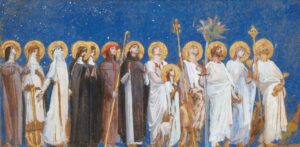
In his Rule for monks, St Benedict gives this admonition: Not to wish to be called holy before one is holy; but first to be holy, that one may more truly be called so (Rule, ch. 4). This advice, which is not lacking in humour (the saints rarely are!), tells us a number of very important things.
First of all, it tells us that it is a good thing to want to be holy. It’s actually necessary to become holy in this life if one desires to obtain eternal life. If we do not become saints, we go the other way, and that we don’t want to do. St. Thomas famously replied to his sister, who had asked him how to become a saint, with just one word: Velle – want it. If you want to be a saint, then you will be, because God certainly wants this for you, and if you unite your will with His, you will achieve the goal.
Secondly, holiness is possible in this life. The saints we honour on this great feast are all there to bear witness to the fact that, regardless of the period they lived in, or the circumstances of their birth, or the lack of education or the hardness of the work or the betrayal of loved ones, etc., it is quite possible for everyone, I said everyone on the planet, to become a saint. That is a very comforting thought, about which more anon.
Thirdly, it tells us that if one is truly holy and is acknowledged as such, it’s not a bad thing at all, because it is crucial that people actually have living saints to imitate, and the one who has truly progressed on the path to sanctity is so deeply grounded in the consciousness of his own unworthiness and the omnipotence of the grace of God that temptations to pride appear to him as utter nonsense: when you have seen face to face your own nothingness – this is one of the greatest gifts God can give in this life – whatever anyone might say about you just ripples off like water on a raincoat. On her deathbed, when one of her sisters asked St Therese if she was a saint, she simply said, ‘Yes, I am’, meaning it’s God’s gift to the nothingness that I am by nature. The glory is all his, not mine.
The same St Benedict reminds the abbot that at the judgment he will have to give an account not only for his own soul but also for those of his disciples (Rule ch. 2). This obviously holds as well for any priest who has responsibility for souls in his care. My job is to make sure that you all become saints. So please do me a favour and make a serious effort. Otherwise, when I reach the pearly gates, I’m going to have to come up with a darn good excuse. I don’t want to have to say: Well, Lord, I gave it my best shot, but they wouldn’t listen…
Now, let’s return to our second point: it is possible to become a saint in this life. Let’s first acknowledge that becoming a saint is serious business. You don’t become a saint relaxing in front of the TV. It’s hard work. But there are many things in this life that are hard work, and if they’re worth doing, they’re worth sweating over. Fortunately, we have a roadmap to sanctity given to us by Our Saviour Himself, and it is laid out before us in today’s Gospel.
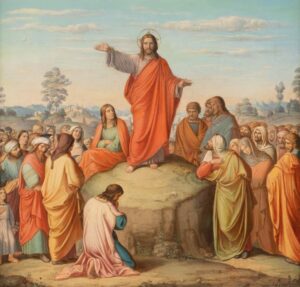
St Matthew spares no details as he prepares his audience for the Sermon on the Mount. He portrays Our Blessed Lord going up the mountain (like Moses on Mount Sinai), sitting down (as the Teacher of all men), His disciples approaching(to listen and to learn, opening His mouth (He who in the Old Testament had opened the mouths of the prophets), and teaching (He did not listen or dialogue). No less than five verbs are present in this one introductory sentence to this most famous of all sermons. It is the sermon that completely transformed the way the world looks at religion, for it turned upside down many of the notions that had been dear to Jew and Gentile alike. Jesus Christ our Lord and Saviour here stands squarely on his own ground, and He answers to no one. As one Rabbi who could not bring himself to convert said: He replaced the Law with Himself. Indeed, the Lord, in the course of this sermon, will say five times: “You have heard that it was said of old to the ancients…. But I say to you”. As Pope Benedict XVI so poignantly remarked in his book on the Life of Christ, only God Himself could make bold to add to the Mosaic Law, and so the One who is speaking can only be God in the flesh, come to teach us the way to Heaven.
To Him then, the Son of God, Jesus Christ our Saviour, we turn all our attention. We listen to the Beatitudes. We’ve all heard them many times, but I doubt many of us could recite them by heart and in order.
Blessed are the poor in spirit: for theirs is the kingdom of heaven.
Blessed are the meek: for they shall possess the land.
Blessed are they that mourn: for they shall be comforted.
Blessed are they that hunger and thirst after justice: for they shall have their fill.
Blessed are the merciful: for they shall obtain mercy.
Blessed are the clean of heart: for they shall see God.
Blessed are the peacemakers: for they shall be called children of God.
Blessed are they that suffer persecution for justice’ sake: for theirs is the kingdom of heaven.
(Mt 5:3-11).
In our daily efforts to become saints, all we need to do is to compare ourselves with the Beatitudes. What do we see when we look into them? Is it like looking into a mirror? Is it familiar to us as a lived experience? When put in situations where we need to be men and women of the Beatitudes, do we find ourselves spontaneously reminding ourselves of them, even if we encounter difficulty in putting them into practice? Or rather, when we read or hear the Beatitudes, is it like seeing the map of a foreign country for the first time, or seeing someone we have never seen before and with whom we have no affinity? Is it like hearing a foreign language that seems so utterly strange to our ears?
A few questions we can ask ourselves on a regular basis:
In our relationships with others, are we full of that gentle meekness that Our Lord tells us elsewhere is the hallmark of those who want to imitate Him? Or on the contrary, do we find that we are ill-tempered, hard, demanding, backbiting, unable to be patient with those who “get under our nerves”?
Do we weep for the evil in the world? Does the devastated landscape of our present-day society move us to tears when we consider the ongoing massacre of the unborn and the elderly, when we see the poor oppressed by the rich and the weak crushed by the mighty? Do we recognise the roots of such oppression in our own attitude, or, on the contrary, are we always pointing the finger at others, without weeping for the failures of our own lives?
Are we inclined to show mercy to those who have fallen, to stretch out a helping hand, to give of our time to help someone recover their dignity? Or are we always demanding that our needs be met, that people apologise to us? Are we always ready to throw the first stone, or are we more inclined to risk much in order to reach the sinner and offer them a way back, a way to return to the only One who can save?
Do we seek to make peace among those who are fighting each other, or perhaps fighting us? Or rather do we pour fuel on the fire by spreading gossip and bad-mouthing those about whom we really don’t have anything to go by other than what “we heard”?
Do we cast upon others a gaze that is pure, that shows respect, that bows reverentially before the mystery of the other person? Are we careful to be modest in the way we dress and act so as to foster that pure gaze in others? Or on the contrary, do we view others as objects that we can use for our gratification and profit? Do we view ourselves as objects to be used? Do we live as if all that mattered were the ephemeral thrills of a life hardly better than that of a beast?
Does our zeal for the faith ever lead us to be the object of contradiction and hurt? Or rather, are we so careful and guarded in what we say about what really matters that no one can ever suspect what we really think, and we will never have to stand up for what is true and holy?
Do we cultivate an attitude of evangelical poverty, making do with what we have, being content with little, sparing our resources so as to be able to help those who are truly in need? Or, on the contrary, do we live behind a mask, a life of pretend in which all that matters is show, in which happiness is equal to possessions and notoriety, but in which the heart remains empty and numb?
If we do make those efforts each day, if we do examine ourselves on the Beatitudes, if we do learn them by heart and have them truly in our heart, although the practice may at first require an effort, we will be led to a place in which it is no longer out of fear, but rather out of true love, and then we will begin to run in the way of God’s commandments.
Already on this earth, we shall have our fill of God, of goodness, of true joy, for already here below we shall see God in others and in all of creation, now become sacred; already here below we shall possess the land of our own hearts and those of others; we shall comfort and be comforted. And more importantly, when our last hour comes, in exchange for a few momentary sacrifices, the eternal kingdom of God and His angels and saints will open wide its arms to us. We will be home; we will be eternally safe, no more pain, no more sorrow, but only God, only goodness, only love, and those we love, only eternal Beatitude. Amen.