
First Sunday of Advent
Each year on this first Sunday of Advent, we hear St Paul seeking to pull us out of our spiritual torpor with these words: It is full time now for you to wake from sleep. For salvation is nearer to us now than when we first believed (Rm 13:11). There is a note of urgency in these words. ‘You have been asleep far too long, and as you slept, the day of salvation approached. Get up and get ready!’
However, when we read the Gospel of this Sunday, we see that the events we are told to make ready for don’t exactly sound like ‘salvation’. They sound more like terror and confusion. Signs in sun and moon and stars, and upon the earth distress of nations in perplexity at the roaring of the sea and the waves, men fainting with fear and with foreboding of what is coming on the world; for the powers of the heavens will be shaken (Lk 21:25-26). How are we to square the day of salvation with the day of terror and wrath?
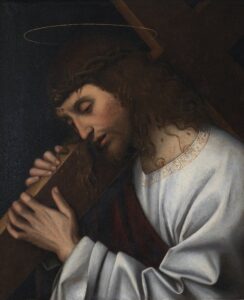
In reality, the Second Coming of Our Saviour will be a terrible event only for those who are not on His side, who have not chosen to listen to Him and follow Him in this life. For them, it will indeed be a time of despair and anguish. But for those whose only real love and concern is our Blessed Saviour and how to imitate Him, there will be great peace and tranquillity. To quote the Imitation of Christ: ‘For they who now willingly hear the word of the Cross and follow it, shall not then fear the hearing of eternal damnation. This sign of the Cross shall be in heaven when the Lord cometh to Judgment. Then all servants of the Cross, who in life have conformed themselves to the Crucified, shall draw nigh unto Christ the Judge with great boldness’ (Book 2, ch. 12).
So the question we face is this: How do we go about living in such a way that the Second Coming will find us in God’s grace and in His peace? How can we make sure we will be among those who look up and raise their heads, because our redemption is drawing near?
This is what the other texts of this Sunday teach us. In them we can see two major themes. The first is the need for conversion and the great care we must take to avoid all vices. St Paul is clear: Let us conduct ourselves becomingly as in the day, not in revelling and drunkenness, not in debauchery and licentiousness, not in quarrelling and jealousy (Rm 13:13). These words continue to ring out in every age, compelling those who fall into such sins to turn back to God, to leave a path that can only lead to despair and eternal perdition. If mortal sin is still something we struggle to avoid, if we find ourselves ever having to confess to such, then this Advent is the time to take the words of the Apostle seriously and to remind ourselves of the imminent end of the world.
The second theme, omnipresent this Sunday and throughout Advent, is waiting with patience and confidence for the Lord. To Thee, O Lord, I lift up my soul. O my God, in Thee I trust, let me not be put to shame; let not my enemies exult over me. Yea, let none that wait for Thee be put to shame (Ps 24). In any worthwhile pursuit in life, patient work and waiting are essential. One does not become proficient in anything without them. Why would it be different for the spiritual life?
For those who, by the grace of God, have reached the stage where mortal sin is regularly distant from us and not something we would consent to, the struggle is more refined, but not less arduous. Indeed, in the spiritual life, to not progress is to regress. One cannot remain static. Either we grow in the virtues, or we find ourselves drifting back to worldly and fleshly attractions. For those who truly want to become saints, it is essential to grow in love. Christ has loved us to the point of not only coming to save us – this we will contemplate at Christmas – but to feed us with His own life. He does this principally through Holy Communion, in which we have the incredible grace of feeding on God Himself.
 The greatest sign of Christ’s love for us is this: He who eats My flesh and drinks My blood, remains in Me and I in him (Jn 6:56). Love always gives, as St Ignatius tells us in the Contemplation to Obtain Divine Love, and we experience this every time we communicate, for the love of Christ is generous; it does not count its effort. In Holy Communion, He gives us all that He has and all that He is. But if we want to be in a position to receive all that He has and all that He is, we must allow Him to take from us all that we have and all that we are. He knows very well that what He is asking of us surpasses our strength, and this is precisely why He enters into us, into the very marrow of our bones, as it were, to strengthen us for the offering of ourselves. In His Love, He seeks to purify all our vices, all our sins, all our imperfections. His desire, in giving Himself to be consumed by us, is that we allow ourselves to be consumed by Him, that we allow our lives to be consumed by His life, so that ultimately the word of St Paul may come true for us: It is no longer I who live, but Christ who lives in me; and the life I now live in the flesh I live by faith in the Son of God, who loved me and gave himself for me (Gal 2:20).
This is Christ’s dream for each of us. Let us not disappoint Him, but rather, let us allow Him a free hand with us. Mother Teresa used to say: ‘I take everything He gives, and I give everything He takes’. Everything He gives is, of course, all the peace and joy that comes with knowing we are in Christ, but it also includes the unpleasant events He allows to happen: the weakness and sickness of our bodies, all our aches and pains and disappointments, unjust treatment, etc. Everything He takes includes the loss of health, the loss of loved ones, the loss of reputation, the destruction of our plans. Blessed Edward Poppe wrote: ‘There are no helps more precious to your work than those who destroy, hinder and oppose it’.
During Advent, my dear Friends, these are the thoughts that should animate us as we await the grace of Christmas, but it all becomes possible only in the measure of our generosity in practising self-denial. The Lord invites us to make efforts to mortify our flesh and our ambitions, our thirst for pleasure and excitement.
As a practical means of making Advent a time of grace, let’s propose just two little penances: first, let’s try and avoid snacking in between meals. This is particularly challenging as we get closer to Christmas and the goodies are readily available! Second, let’s put a pause on the intense exercise our fingers get from mindless scrolling on our phones and computers. Use the internet wisely when there is a need. Do not become its slave. These two things will not kill us! On the contrary, they will revive us not just spiritually, but also physically, forcing us to employ our time in healthier activities.
Finally, let’s spend Advent according to the mind of the Church, close to Mary Immaculate, as she prepares for the birth of the Infant God. Let’s leave the feasting and celebration of Christmas until …. Christmas! Then, all together, we will celebrate in joy God’s greatest gift to us.