
17th Sunday after Pentecost
In today’s Gospel, we find Our Blessed Lord giving the Pharisees what we might call the first lesson in Christian apologetics, that is to say, the defence of the faith that St Peter already said all Christians must be able to perform. Always be ready to make your defence (apologia) to anyone who demands from you an accounting for the hope that is in you (1 Pt 3:15-16). In other words, we must all be ready at any moment to explain to others why it is we believe in God and in all that He has revealed through His Son. Let’s turn our cameras toward Our Blessed Lord’s direction as He shows us His methods.
First of all, we are in the context of debates with the Sadducees and the Pharisees. The Lord had silenced the first who had tried to trick Him into acknowledging that there is no such thing as the Resurrection. When the Pharisees hear about the confounding of their adversaries, they figure this is their time, so they send one of theirs with a question designed to force Our Lord into the polemics of the time, which would discredit His novel teaching. The Pharisees had long argued over the more important parts of the law, and there were any number of views. So the question, which St Matthew points out was really a test, was this: Master, which is the great commandment in the law? (Mt 22:36).
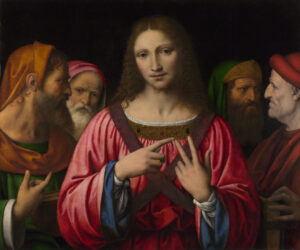
Our Lord does not fall for the trap, but takes the question at face value and answers in a way that immediately outplays the Pharisee, lifting the entire debate to another level: Thou shalt love the Lord thy God with thy whole heart and with thy whole soul and with thy whole mind. This is the greatest and the first commandment (Mt 22:37-38). The implication is clear. What Our Lord means by this answer is quite simple: I know you Pharisees, I know you, that you have not the love of God in you, as He had told them earlier (Jn 5:42). You debate about God and religion, but the very heart of religion you do not know and do not care. He then adds: And the second is like it, You shall love your neighbour as yourself. With these words, Our Lord teaches them yet another lesson: If you really want to debate spiritual matters, if you want to argue religious subtleties, you must never leave charity aside, for if you do not have this, all the rest will be of no benefit, but rather a motive of greater condemnation.
Our Blessed Saviour does not let them off the hook so quickly, though. The Good Shepherd wants to give them a chance to redeem themselves, so He Himself proposes a simple question, one that has a simple answer, but that will open up an entirely new vista for whomever is willing to take the step.
Turning the tables, He now does the asking: What do you think of the Christ? Whose son is he? There really was no hesitation to have here, and the answer comes swiftly: David’s. Very good, various Old Testament prophecies make it clear that the Messiah will indeed be the son of David. Our Lord goes on: How is it then that David, inspired by the Spirit, calls him ‘Lord’, saying, ‘The Lord said to my Lord, Sit at my right hand, till I put thy enemies under thy feet’? (Psalm 109). Let’s stop here for a moment and weigh the import of this question. The Pharisees had rightly acknowledged that the Christ would be the son of David. But what is perhaps the best known of all the Psalms begins with David addressing God, his Lord and speaking to the Messiah – whom we have just seen is the son of David- addressing him not as ‘my son’ but as ‘my Lord’. The same title, Lord, is clearly referred to both God and the son of David. And so Our Lord is able now to play His ace card and ask His question: If David thus calls him Lord, how is he his son?” (Mt 22:42-45).
How can a man be both son and Lord of the same person? The Pharisees had heard and prayed and sung this psalm all their lives, but had not understood it. Indeed, until the coming of the Messiah, it could not be understood. But now when they have the Messiah standing there in front of them and pointing out the mystery, they are silent. The answer was not difficult, and had they been upright and really seeking the truth, it could have gone something like this: ‘The scriptures tell us the Messiah would be David’s son. But David himself refers to him as Lord. So in some way, he must be both son and Lord of David. How can that be? What is the secret to understanding this mystery we have never thought about?’ If only they had asked that question, they would have been saved, for the very asking would have been proof of their openness to receive the truth. But the secret to the right answer is both humility and love, which is why the Lord took advantage of the previous question to ask this one. And the reason they fail the test is that they do not have the love of God in their hearts.
I think most of us have experience of something similar. When speaking with someone who does not believe in God, or in Christ or who is not a Catholic, we may declare a point of doctrine that is so clear and so irrefutable that it really does not admit of any other answer than the one the Church gives. And the person we are talking to does not answer, or turns the conversation in another direction. The answer is easy; it is simple, but its simple truth cuts to the very heart of the person who is not ready to receive it.
St Matthew adds: No one was able to answer him a word, nor from that day did any one dare to ask him any more questions. The Sadducees and then the Pharisees had been silenced; they had been humiliated. Their only answer was to stop debating with our Lord, all the while plotting His death. So it is that some people cannot bear the truth. They prefer to remain in the dark and never come to the light. They remain under the influence of the diabolical contagion of which this Sunday’s oration asks to be delivered. What is diabolical contagion if not sin and all that leads to sin? What is it if not pride that refuses to acknowledge one’s errors, that will not make the effort to understand, because it fears the effort that will be required in the change of one’s ways?
But our methods of evangelisation need not change. The Gospels give us a paradigm for which no other can be substituted: the simple, charitable presentation of revealed truth, and straightforward questions that allow souls to draw their own conclusions. If they fail to do so, let us not give up on them, but rather pray for them, so that the light that was shown may one day penetrate their heart and that they too will come to share with us the true faith.
St Paul’s words to the Ephesians in today’s epistle reveal to us the fundamental attitude we must have and at the same time the goal to which we aspire: I beg you to lead a life worthy of the calling to which you have been called, with all lowliness and meekness, with patience, forbearing one another in love, eager to maintain the unity of the Spirit in the bond of peace. There is one body and one Spirit, just as you were called to the one hope that belongs to your call, one Lord, one faith, one baptism, one God and Father of us all, who is above all and through all and in all (Eph 4:1-5)
 In conclusion, let’s note that it is no accident that this unique question of Our Lord revolves around His own identity. The Person of Christ is really the most fundamental question in Christianity, the most important question ever asked. Who is Jesus Christ? He is both God and Man. In His Person, He unites God with humanity and is therefore the model that we must imitate, the guide that we must follow, the teacher we must listen to, learn from and obey. It is in listening to Him and in following Him that we learn the true love of God and can grow in it.
And so, on this day, let us ask ourselves the fundamental question: Do we obey and live that first commandment? Is love for God the driving force in our lives? Do we think of God first thing in the morning and entrust ourselves to Him before closing our eyes in the evening? Do we turn our thoughts to Him frequently during the day as one who is in love and cannot get the Beloved out of his mind? If not, then let us ask Our blessed Lord to teach us what this true love of God is. Ask and you shall receive (Mt 7:7). And when He asks you the question, Do you love me more than these? (Jn 21:15), be sure not to change the subject. Just give the answer, the right one.
And if you are afraid you do not yet know how to love, that is not a problem, for true love is an apprenticeship; it takes time for it to grow and take over in our lives. The main thing is to want to love, for if you want to love, then you already do, even though you must progress. In this fascinating journey to true love, turn to Our Blessed Lady and ask her guidance, for no one loves God more than she, and as a good mother, she is ready to share all that she has, and therefore her love. All that is mine is yours (Lk 15:31).