Corpus Christi
In today’s Gospel, we see Our Blessed Lord sending His servants to invite to His banquet those for whom it was destined. One after the other, they reject the offer. One pretext is that he has bought a new farmhouse and has to go and see it; another that he has just purchased five yoke of oxen and must try them; a third that he has just married and so cannot come. All three are doing things that are perfectly legitimate. They are actually the stuff of which life is made: providing for oneself, having a decent place to live and founding a family to provide for posterity. What could be more human than that? And yet, when the master hears these excuses, he is angry, very much so in fact. Why would he be angry with people for getting along with their lives?
The point is that it’s not the normal human business of life that is the problem. Rather, the problem is getting so deeply entrenched in one’s affairs that one loses sight of the more important things. The problem is allowing earthly considerations to take precedence over the spiritual, which in turn means, if not in theory certainly in practice, that all that really matters is this life. At the end of the day, it means that we are just sophisticated animals and no more.
Against this, St Gregory the Great, in a homily that we read this morning at Matins, helps us to understand why so many fall for this worldliness that does not please God. He writes of the difference between the pleasures of the body and the pleasures of the soul. When we do not have those of the body, we long for them, but when we get them, we are quickly disgusted, for bodily desires are quickly satisfied and engender nausea. On the contrary, when we do not have the delights of the soul, we do not desire them, and we let ourselves be distracted by fleshly ones. But if we persevere in seeking the pleasures of the mind and the soul, once we have them, we only want more of them; we can never get enough.
And here we have the crux of the matter: most people have neither the patience nor the will to embrace spiritual delights. One must make an effort to spend time with God, who gives generously to those who knock at the door. Most people sadly prefer to go from thrill to thrill, and undergo the enduring sadness of this life, and they remain forever outside the abundance of joys and profound delights that are the share of those who give substantial time to God each day.
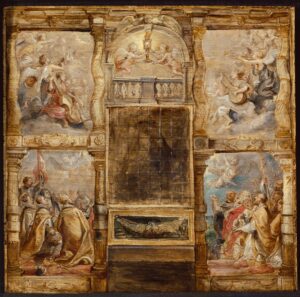
And this brings us to the whole point of Eucharistic adoration. Often when we go and spend time before the Eucharistic Lord – either enclosed in the tabernacle or exposed on the altar, it’s all the same – we can find ourselves, as it were, in a desert. We don’t feel or see anything, and there are plenty of distractions. If we give up too quickly, then we come away empty, very much like a man who would be invited to a sumptuous banquet and who would be content to look at the food for a few minutes and then walk out – he has not put the time and energy into actually doing what is required to nourish himself, that is, sit down and eat. The Lord Himself is there in the Most Blessed Sacrament, offering His grace to all those who approach Him in faith and with perseverance.
Some may object that the time spent in adoration would be better used in serving the poor and the needs of the apostolate. In reality, our time before the Eucharist gives us strength for the apostolate and for serving the poor. This is why today’s epistle insists upon fraternal charity: In this we have known the love of God, because He hath laid down His life for us; and we ought to lay down our lives for the brethren (1 Jn 3:16). It is by contemplating the love Christ had for us in offering His Body and Blood that we learn to imitate His love in serving our brethren. This is why the saints drew from this most blessed Sacrament the grace to make of their lives a continual offering to God and to the service of those in need.
This is why, at the end of Mass, we are sent out by the priest to go and bring Christ to others, especially to those who do not yet know Him. This is also one of the meanings of St Paul’s words to the Corinthians: For he that eateth and drinketh unworthily eateth and drinketh judgment to himself, not discerning the body of the Lord (1 Co 11:29). Not discerning the Body signifies two things. It means not acknowledging that the Body of Christ is truly present and therefore treating it as if it were ordinary bread – and this points to the duty of being in the state of grace when one approaches the altar, for it is a grave sin to approach the Sacrament of Light when one’s soul is in the darkness of mortal sin. It also means not acknowledging the mystical Body of Christ, of which we are all members through Baptism; it means not acknowledging all the other souls who are in Christ; it also means not acknowledging all those who, though not yet in Christ, are destined to be, thanks to our words and examples. In this, we see clearly that devotion to the Holy Eucharist opens us up to the needs of our neighbour. The more we spend time with Him, the more we want to share Him with others, which is the deepest meaning of the Eucharistic procession: we walk together with the Lord towards eternity, striving to live in harmony with all our brothers and sisters, and bringing into the fold those who are still outside, lest they die of wretchedness and hunger.
Let us turn to the Mother of the Eucharistic Heart of Jesus, she who gave us the Sacred Flesh that we consume in the Blessed Sacrament, the Flesh that we worship, the Flesh that embodies the fullness of the Divinity, the Flesh that teaches us to reverence His presence in all those in need, the glorified Flesh that will be our joy for all eternity.