
Pentecost Sunday
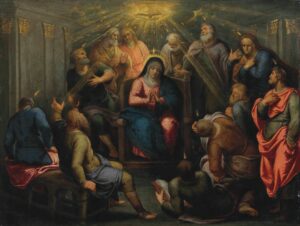
We have heard the story many times, and our familiarity with it risks preventing a deeper penetration into the mystery of this most sacred day of Pentecost. The Third Person of the Blessed Trinity, the Holy Spirit, promised by Our Lord, is poured out upon the Church gathered around Mary Immaculate and the Apostles. The Apostles sing the praises of God and then begin to preach.
First lesson: Prayer and praise always play a primordial role in the Church. This is the reason why there is no form of life within the Church that is so important for her vitality as the contemplative life, which affords monks and nuns the leisure, throughout each day and night, to glorify the Most Holy Trinity for all its graces and benefits to humanity. Using the very words that God has given us, under the influence of the Holy Spirit, they thus do, in the name of all humanity, what men were destined to do: unite with the Angels in unceasing praise of the Godhead. Without this constant support of prayer, those who are preaching the Gospel, like those who are taking care of the poor and the sick, would have no grace and no spiritual energy to acquit themselves of their task. Let’s not forget: prayer, praise, and the glorification of God always come first. Without it, nothing works, nothing at all. Nothing can work, neither in our personal lives nor in the Church at large.
Hot on the heels of prayer, however, comes the preaching of the Word, bearing witness to the truth. Our Blessed Lord, in the Gospel we read yesterday for the Vigil, referred to the Holy Spirit as the ‘Spirit of Truth’. When the Holy Spirit is received into a soul, that soul is, as it were, propelled to proclaim the Truth to all those who will hear, and even to those who won’t. As the head of the apostolic college, St Peter is the first to speak out. His discourse is fundamental, and it is paradigmatic for all preaching in the Church. And what does he say?
He first cites the prophet Joel as having foretold the event centuries beforehand. In so doing, he links the Old and New Testaments. The Gospel does not appear out of nowhere, nor is it in a vacuum. For centuries, God had been preparing this moment, and it has come. The Jews were the Chosen People to whom the guardianship of the prophets was entrusted. Christianity is built upon Judaism and brings it to its completion. Neither can be understood without the other. It would be as absurd to pretend that Christ initiated another religion opposed to Judaism as it would be to say that today’s Jews have no need of Christ. No, God knew exactly what He was doing when He formed His people in the Old Covenant and prepared them for the full revelation of Himself in the New, the completion of which takes place on this very day, with the outpouring of the Holy Spirit. As St Leo the Great tells us in a homily for this feast: ‘The grace of Christ was foretold by the Law of Moses, and that Law was brought to its fulfilment by the grace of Christ’. Second lesson: to be a true Christian, one must know and venerate the Old Testament, for it prophesies the events of the New Testament, of which we are privileged to be a part.
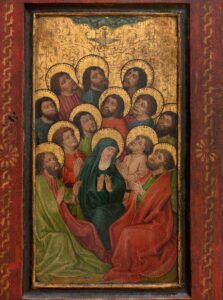
St Peter then proclaims that Jesus was sent by God, His countless miracles bearing witness to His divine mission. This Jesus whom God sent to you as Saviour, you rejected Him, you killed Him. But God raised Him up on the third day and made Him Lord of all (Acts 2:23-24)… Here too, St Peter quotes the Old Testament, this time a Psalm (15), showing that the resurrection of Jesus had been prophesied all along and has actually now come to pass. In these words, which constitute the very first proclamation of the Resurrection to the world, are summarised all the mysteries of Christ, and thus contain, as in a seed, all of the Christological and Trinitarian dogmas that will be developed in the early centuries of the Church against those who sought to deform them. Third great lesson: Far from being a cult whose beliefs depend upon the sway of those who happen to found it or lead it in a given period, the Catholic Church bases every single one of the articles of its Creed on the revelation of God come in the flesh. The Holy Spirit, poured out today, is constantly urging souls to look to Christ, who is the Way, the Truth and the Life, the only way to the Father, the Name outside of which there is no salvation (cf. Jn 14:6 and Acts 4:12).
Just as the second part of St Peter’s sermon is dogmatic, so the third part is of a moral tone. Hearing his words about Christ, the Jews are moved, cut to the heart. That is to say, the words of this first homily move them to question their own conduct, and this is what every homily should do. They ask Peter and the rest of the apostles, Brethren, what shall we do? And Peter said to them, ‘Repent, and be baptised every one of you in the name of Jesus Christ for the forgiveness of your sins; and you shall receive the gift of the Holy Spirit… Save yourselves from this crooked generation’ (Acts 2:37-41). Once again, we have here, as in a nucleus, all the moral teaching of the Church. Fourth lesson: Conversion always begins with a reproach that cuts to the heart, that causes compunction, that moves us to change our way of living and turn to God.
Now, let’s draw some conclusions for the Church today. Gigantic efforts can be seen to transform the faith handed down by the apostles, to keep its cover and its vocabulary, while depriving it of its life and turning it into a purely human philosophy that makes people feel good about themselves. One of the hallmarks of this movement is to play down Catholic dogma in every possible way, protesting a preference for language that is more pastoral and less dogmatic. Fifth lesson: It is not possible to be truly pastoral without first being dogmatic. All pastoral activity in the Church is based on handing down the revealed dogma. Let us never forget that the Holy Spirit is the Spirit of Truth. He reveals the Truth, and He keeps the Church as a whole faithful to that truth. Do not let yourselves be impressed by the number of those who want us to believe in their new kind of Church. The one true Catholic and Apostolic Church will remain, even though many may be lost to her, and there may only be a tiny remnant (that too was prophesied). In the end, the Spirit of Truth will triumph once again.
In the meantime, we must be prepared, like the apostles, to be hated and mocked. The Jews mockingly said that the apostles must have had too much to drink: But others mocking said, They are filled with new wine (Acts 2:13). Today, their heirs mock those who hold firm to the faith and morals of our ancestors. They sneer when we say that it is not possible to compromise on the dignity and majesty of the Holy Sacrifice of the Mass; it is not possible to turn the Mass into a social gathering. They poke fun at us when we condemn their promotion of immoral lifestyles and will have nothing of their efforts to normalise what is abnormal, to call straight what is crooked. But that matters not to us. We have the Spirit, that Spirit whom St Augustine told us yesterday in a magnificent homily for the Vigil of Pentecost can only be seen invisibly – invisibiliter videtur. He can only be seen invisibly because it takes an effort to pray, to have an interior life, to impose silence on our tongue and give God substantial time each day in adoration and praise that tells Him how much we love Him. Sixth lesson: take refuge in silent prayer, for there the Spirit of God will show Himself to you.
The Benedictine Pope, Pius VII, who had twice been dragged across Europe by Napoleon and kept in prison for five years, knew the truth of that. In an era when the very existence of the Church was so seriously threatened, he took refuge in prayer and, on this day, 24 May 1814, to honour Our Blessed Lady’s intervention to save him, proclaimed this feast in her honour, Our Lady Help of Christians. Like Pius VII, we move on in spite of what we might have to suffer. We know the One in whom we have put our trust. The Holy Spirit, the sweet Guest of our souls, gives us strength, He gives us consolation, He makes us to experience inner joy that the world cannot even dream of, because it is so immersed in the pursuit of animal-like pleasures. Seventh lesson: when all seems lost, turn to the Immaculate Heart of Mary, she who, as an ancient prayer tells us, destroys all heresies in the whole world, and delivers the true servants of her Son.
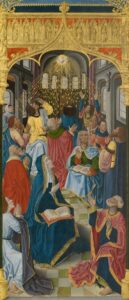
The world scorns us when we call it to repent of its vices and say to it: Save yourselves from this corrupt generation. It smiles at us in a condescending way, as if to say: What have you been drinking? And we know that, well, there is truth in what they say. We are drunk, we are oblivious to what they offer. We know it is insipid, tasteless, revolting even. Only the pleasures of the Spirit draw us, and we neither want nor need any others. Yes, we have had too much to drink, and yet we want more. Let the Spirit be given to us in abundance so that we can forget the nightmare that surrounds us. Let us pray that one day we will awake from our drunkenness and open our eyes to see that the veil has finally been lifted. The Triune God is no longer invisible, but has allowed us entrance into the eternal dwelling place, where the Lamb is the eternal light and the Spirit carries us away into the ocean of God’s love.