
Last Sunday after Pentecost
 On this last Sunday of the liturgical year, Holy Mother Church places before our eyes the end of the world and the troubled period that will precede it. The great sign the Lord gives us is the “abomination of the desolation”. What is meant by this “abomination of the desolation”? It has been variously interpreted by the Fathers as the statue of Cesar that Pilate had placed in the temple of Jerusalem, the statue of the emperor Hadrian on horseback which was still there at the temple site in the fourth century, or of the Antichrist himself. St Jerome adds, however, that we may also understand by the abomination of the desolation any bad doctrine that finds its way into the Church.
This seems to be confirmed by the Catechism, which teaches: “Before Christ’s second coming the Church must pass through a final trial that will shake the faith of many… The persecution that accompanies her pilgrimage on earth will unveil the ‘mystery of iniquity’ in the form of a religious deception offering men an apparent solution to their problems at the price of apostasy from the truth” (Catechism of the Catholic Church # 675).
What is a religious deception that offers an apparent solution leading to apostasy from the truth if it is not a bad teaching, an evil religious doctrine? The key point to understand here is that the final attempt of Satan to destroy the true faith on earth will not be the destruction and total absence of religion in an entirely secularised society. This could not work quite simply because men, who are by essence religious creatures, ultimately shun such an ideology after a while because it can only reduce them to the level of the beast, and no one wants to be a beast. Rather, the final persecution will be through a false religious teaching that distorts the truth, that replaces God’s revelation of Himself in Jesus with the dethronement of Christ in place of the man of lawlessness …, the son of perdition, who opposes and exalts himself against every so-called god or object of worship, so that he takes his seat in the temple of God, proclaiming himself to be God (2 Th 2:3-4). In other words, the Enemy of our salvation will unleash his final assault under the appearance of a false religion that will captivate the minds and hearts of many and lead them into apostasy from the true God.
How will all this come about? Our Blessed Lord gives us today a few elements to be aware of, but not enough for us to know exactly when and how it will all come about. The point is that we must always be on our guard. This is the reason for the admonitions our Blessed Lord gives us in today’s Gospel. These two warnings in particular should catch our attention: flee to the mountains, don’t go back to take anything with you. Beyond the purely utilitarian recommendation not to lose time when there is no time to lose, these words of our Saviour hold a deep mystery and a profound lesson for each of us.
First of all, they admonish us to leave behind our personal ambitions and all self-seeking. This is the gate through which all forms of vice and error strive to undo the work of the Eternal God in our souls. The person who seeks his own interests will always be an easy prey to vice and error, as is all too evident in the world around us. Let him who is on the housetop not go down to take what is in his house; and let him who is in the field not turn back to take his mantle (Mt 24:17-18). That is to say: strive for detachment from worldly things so they have no power over your soul to lead you into error. In other words, it is the ever-repeated maxim of self-denial. Life is not a party. It is warfare, and our immortal soul is what’s at stake.
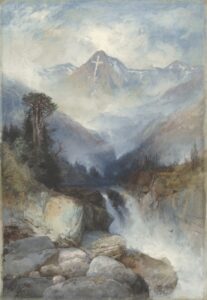
Secondly, and more importantly, the Lord tells us to flee to the mountains. What are these mountains if not the symbol of God Himself and His Church and her sacred doctrine, of the saints and their wholesome teachings on the spiritual life? To take refuge in the mountains means leaving behind worldly and fleshly pursuits, and making the effort to climb the mountain of our heart. What does it mean to climb the mountain of our heart? There are many people who climb mountains. Conquering the highest peaks of the planet has long been a fascinating project for the elite. But to climb and conquer the mountain of the heart, what does that mean? It means by careful, persevering training to rise above all the passions of our soul; it means to train ourselves to soar above all that would pull us down to lowly considerations; it means to aspire continually to worship God in spirit and in truth, as opposed to becoming infatuated with what flatters our senses; it means to accept that we do not have in ourselves the means of accomplishing these things; it means to rely solely in God’s grace; it is to cooperate with that grace and set aside time each day – I repeat each day – to spend time climbing to the summits, lest we be dragged down into the abyss of self-seeking or self-pity, which are really the same thing. To climb the mountain of the heart is essentially to get out of oneself. The climber of Mt Everest finds himself on top of the world. The climber and conqueror of the heart finds himself master of his/her own passions, up there where all is peace and tranquillity and where the noise of the world cannot reach.
The writings of the saints are replete with advice on how to do this. Let’s refer once again this week to St Elizabeth of the Trinity, commenting on these words of Our Lord: “Because I love My Father, I do always the things that are pleasing to Him”. She writes: “Thus spoke our holy Master, and every soul who wants to live close to Him must also live this maxim. The divine good pleasure must be its food, its daily bread; it must let itself be immolated by all the Father’s wishes in the likeness of His adored Christ. Each incident, each event, each suffering, as well as each joy, is a sacrament which gives God to it; so it no longer makes a distinction between these things; it surmounts them, goes beyond them to rest in its Master, above all things. It exalts Him high on the mountain of its heart, yes, higher than His gifts, His consolation, higher than the sweetness that descended from Him. The property of love is never to seek self, to keep back nothing, but to give everything to the one it loves. Blessed the soul that loves in truth; the Lord has become its captive through love”.
Further, she comments on these words of St Paul “You have died and your life is hidden with Christ in God”: “You have died! What does that mean but that the soul that aspires to live close to God in the invincible fortress of holy recollection must be set apart, stripped, and withdrawn from all things. This soul finds within itself a simple ascending movement of love to God, whatever creatures may do; it is invincible to things which pass away, for it transcends them, seeking God alone.”
Over the soul that truly seeks God and truly proves it by giving Him time every single day, the soul I say who is passionate about God, none of the temptations the Lord mentions in today’s Gospel will have any sway. People may come and say such things as: “We’ve now found a better religion than Christianity”, or “we’ve finally understood what Christ was about”, or “thanks to AI we’ve finally found the secret to world peace”, etc. All this will be nothing but nonsense for such a soul who has already come to know Christ because it has learned to climb the mountain of its heart. For that soul, the days indeed will be shortened, for the soul immersed in God loses contact with the passage of time. Nothing matters anymore but God Himself, who became incarnate in Jesus Christ. Such a soul knows by experience the truth of those words: Heaven and earth will pass away, but my words will not pass away.