
4th Sunday after Pentecost
Anyone visiting St Peter’s Basilica in Rome cannot fail to be overwhelmed by the majesty of one of the most awesome edifices ever constructed. And in honour of whom? A poor, ignorant, feisty fisherman from Galilee. We shall soon honour the Holy Apostle Peter, along with St Paul, with liturgical solemnity, but today we are fittingly given to meditate in the Gospel of this fourth Sunday after Pentecost, the key moment of the vocation of Simon Peter.
He and his companions have spent a long night on the lake, hopelessly trying to take in some fish. It is now morning; they are tired; the Rabbi from Nazareth asks to use their boat for a sermon, and they comply, but really, they had had enough; their spirits were low. Indeed, fish is the livelihood of fishermen, and no fish means no pay. The future was not bright.
Having finished his homily, Jesus gives Peter an order, a command. This in itself was surprising. Jesus knew nothing about fishing. That was Peter’s job. What must not have been the surprise of them all to hear the Rabbi say: Duc in altum – Launch out into the deep and let down the nets for a catch. Launch out into the deep. So now, after working all night with nothing to show, after listening to an early morning sermon on an empty stomach, after all that, we are now asked to go back out into the deep waters for a catch that can only be fruitless? Peter knew the lake; he knew his business. With this in mind, we can only admire his reply: Master, we have laboured all the night and have taken nothing: but at thy word I will let down the net. In spite of an objection in which we can sense a bit of irritation, Peter obeys. He obeys a command that, to all appearances, makes no sense. He renounces his own will, his own interests, he submits his judgment and obeys – so begins the new life of Simon Peter.
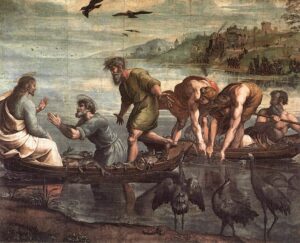
What does this miraculous catch of fish symbolise? First of all, it proves our Blessed Lord’s divine mission, and at the same time, it prefigures the apostolic mission of the disciples. Just as they catch fish from the deep waters and bring them into the ship for the service of man, so the apostles will bring in souls from the deep waters of a sinful life in the world, to enter the Church and finally be brought into the heavenly kingdom symbolised by the shore. Henceforth, you will be fishers of men. Henceforth, your only passion must be to bring souls to Christ and to salvation.
Launch out into the deep – Duc in altum. The deep is clearly the large expanse of this world. The apostles’ mission will take them to the utter ends of the earth, to all souls without exception in every age and every clime. This word has ever been a stimulus for apostolic labourers in the Church, to not be afraid to carry the Gospel into every situation, and at any risk. All souls must be brought to Christ, and that can happen only through the preaching of the Gospel. Peter, like the other apostles, will pay for his courage in bringing the Gospel to Rome: the Eternal City will be consecrated by his blood, poured out as a witness to Christ.
But the words Duc in altum have another meaning, and it is this: we must put out into the deep of our own hearts, that bottomless well of our being in which God is waiting for us. We must admit that this is no easy task. The fickleness of our nature is such that we all too often content ourselves with the superficial, the facade, the appearances. It takes effort to move beyond, to enter into the depths of our heart, to put out into the deep waters of a real and authentic spiritual life, to accept to not only wade out into the shallow waters but to actually plunge into the depths, without fear, trusting in the infinite love of the Sacred Heart into which we are invited to immerse ourselves.
In every age of our world, in every stage of our individual lives, the word of Our Lord, Put out into the deep, is there to goad us on to an ever-deepening relationship with Him, with the truth, with Love. St Augustine’s journey, so masterfully presented int the book of his Confessions, and which remains a model for any true conversion, is there to show that fallen man is constantly being dispersed here and there on the surface, his mind and heart are continually drawn away from the authentic realities, the essentials of our very being, and such distractedness distends and disfigures the very fabric of our soul and body created in the image and likeness of God. And so it is that every return to God, every conversion, of necessity, starts with a progressive return to the interior, to the depths of that heart created by God and thirsting for Him. “I was on the outside, but You were on the inside”, writes Augustine. I was running after the shadows, and in so doing, was running away from reality.
Let us welcome then, Our Lord’s invitation on this day to put out into the deep. Let us not fear to spend time with ourselves, to live with ourselves, as St Gregory tells us the young Benedict did during his three years in Subiaco. Habitabat secum. There are few who really live with themselves, for there are few who accept to look straight into their own heart, to face the shadows that are there, allowing the bright light of Christ to penetrate and dispel the darkness. It is sad, but most people make great efforts to avoid entering into themselves and going into the deep waters of the knowledge of self, the gnothi seauton of Socrates, the accedet homo ad cor altum of Psalm 63, the deep well in Samaria where Jesus Our Lord meets the sinful woman and inaugurates in her heart a path of conversion (Jn 4).
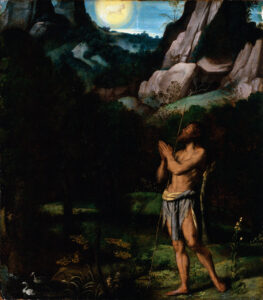
This week, we will celebrate St John the Baptist, who went off into the desert as a young boy and would stay there for many years, learning the ways of the Lord, being fortified by His grace and by intimate conversation with the Bridegroom of our souls. It was only once he had been fully prepared by so much asceticism that he was ready to be launched out into the deep of preaching to the world, because he had already met God in the depths of his own heart.
At several critical moments in the history of the Church, we see the same thing happening. In times of decadence and turmoil, a group of men sets out to found a monastery, a religious community, to live a simple life like that of the apostles. And in so doing, they allow the Holy Spirit to purify them and make use of them to save the world. It happened in the Dark Ages with the foundation of Cluny and Cîteaux. It happened in the sixteenth century with the foundation of the Theatines and the Jesuits. It happened in the nineteenth century with the numerous congregations founded in France, recently devastated by the Revolution and the Napoleonic wars. In every age, the Spirit of God raises up souls who rise to the task.
Today too, the scene of the world is tragic, and the Church finds herself in dire straits, unprepared, so it would seem, to meet the challenge. Now it is that we need men to accept to put out into the deep of a truly ascetic spiritual life, as close as possible to the apostolic model. From that depth, the Lord will be able to bring forth a miraculous catch of fish, in His time and in His way. Our job is to become saints. And saints are those who obey the voice of Christ and who are ready to go anywhere and to do anything He commands.
In our age of ceaseless distractions, those words Duc in altum are there to remind us to turn off the noise, to turn our gaze to the heart where the Blessed Trinity dwells. While the monastic life remains the model of this interior attentiveness to the presence of God, it does not have a monopoly over it. Monks and nuns serve the role of being an inspiration to our contemporaries to refuse the futile distractions of the world and seek to go down deep into the well of prayer, silence, and contemplation. For in God alone there is peace, and we, as Benedictines whose motto is PAX, must be always and everywhere men of peace, men who, because they are always in the depths of the ocean of divine love, can hardly feel the turmoil of superficial tempests. There, in the depths of the Sacred Heart, that is, in the depths of our own heart where we meet the Divine Heart, there alone is eternal peace and eternal stability.
Remember, every time you hear of or visit St Peter’s Basilica, that awesome edifice would not exist, the Catholic Church would not exist, if that poor fisherman had not, one bright morning on the Sea of Galilee, obeyed an order that made no sense, and allowed himself to be led, in faith, along a path of true conversion. In faith, he obeyed, and so the Church began. All things are possible for the one who believes (Mk 9:22).