Third Sunday after Pentecost
Today’s oration presents us with a summary of the faith and the spiritual life. The Latin prose of these ancient prayers is dense, concise, and no words are wasted. Because of this, in order to do justice to the oration in our language, it is sometimes helpful to take the translator’s freedom and propose a paraphrase, such as this:
O God, since Thou are the protector of those who place their hope in Thee, and without Thee no one can be healthy, no one can be holy. Increase in us the manifold tokens of Thy Mercy. Under Thy rule and following Thy lead, may we pass through all the temporal goods that surround us without losing the everlasting goods that await us.
By means of such prayers, Holy Mother Church plays her role as teacher and passes on to us, her children, some very fundamental points about how to reach Heaven.
God protects those who place their hope in Him. If we truly hope in God, if we have confidence in His aid, then He infallibly offers it to us. We can also deduce from this that He does not offer the same degree of protection to those who do not acknowledge Him nor hope in Him. Why is this? Quite simply, because the existence of God can be known by human reason alone, and if someone does not come to such faith, we must conclude that they have not yet reached a point where they are open to the beneficent influence of God’s grace. This is why God sometimes allows people to founder in terrible situations, with the hope that they will one day wake up and turn to Him. All the ways of the Lord are mercy and truth, to them that seek after his covenant and his testimonies (Ps 24:10), words echoed in the prayer of Tobias: Thou art just, O Lord, and all thy judgments are just, and all thy ways mercy, and truth, and judgment (Tob 3:2).
With God, there can be no health of mind or body. All sanity, all fitness and well-being flow from God as from their source. This is why it is perfectly legitimate to ascribe all kinds of illness and disease ultimately to the Devil. As the Book of Wisdom teaches: For God made not death, neither hath He pleasure in the destruction of the living (Wis 1:13). It is the Devil who caused suffering and death: By the envy of the devil, death came into the world (Wis 2:24). This is also why people are perfectly justified in asking God for miraculous cures, and God in His goodness sometimes grants this, as we can see even today in places like Lourdes.
The same can be said of holiness. Outside of God, there is no holiness of any kind, for anyone who approaches God and starts to be Christlike does so only by means of the grace of God. One consequence of this is that in the ordinary course of events, God’s grace comes to us through the channels He Himself has given us: His Church and the seven Sacraments. This is why sanctity is one of the marks of the Church, and why the Church never ceases to canonise new saints in every age. This does not prevent the grace of God from being operational outside the visible bounds of the Church, especially for those who are ignorant of His truth, and yet, all grace that is given comes to the world through Christ. It’s what the great Swiss theologian Cardinal Charles Journet called the ‘Christic grace’, meaning that in God’s economy of grace, there are no graces that are not stamped with the seal of Christ, the Son of God, who merited those graces by His passion and death. One conclusion we can draw from this is that we must never despair of the salvation of those who are outside the visible confines of the Church. We must pray that they will open themselves up to grace and follow its lead, and arrive, sooner or later, at the fullness of the truth.
And so it is that the oration then proceeds to beg God’s mercy, more specifically, to beg Him to pour it forth in abundance, in repeated and prolonged offers of grace. The Latin verb multiplica indicates a repetition of such offers, so that even those who are slow to understand may finally catch on and truly turn to the Lord. What is the goal of this mercy that is given to us? Is it given to make us feel good about ourselves? Is it offered so that we may live in sin and presume on God’s mercy? Not at all. The mercy we ask for takes shape and form in a very practical way, by following the lead of God, to let ourselves be led by Him, and truly converted to a life of holiness. How do we know that we are doing that?
We know it if we make use of the goods of this life in the way that God intended, that is to say, that we use them according to our needs, without getting overly attached to them, never misusing or abusing them for our personal gratification, remembering too that all the goods of the earth have been given to all of humanity, and therefore sometimes the proper use of a good thing is to give it to one who is in need. It’s what we call the universal destination of goods. All the goods of this life, which are everything that we know or can experience, have one single goal, and that is to help us reach the eternal goal, and that eternal goal, no one reaches it alone. We cannot expect to save our souls if we do nothing for the salvation of our neighbour.
How foolish would that person be who would so give himself to something that passes, a thing that is here today and tomorrow is gone, in such a way as to make that perishable object his own little god. To lose eternal goods for a passing satisfaction! How insane is that? So it is that Holy Mother Church, by means of these liturgical prayers, forms us and teaches us how to live our lives.
The other texts of today’s Mass are consonant with this message. In the epistle, St Peter tells us to humble ourselves, to make ourselves small, to not consider ourselves to be the centre of the universe. Be humble, put all your trust in God, and be on your guard against the enemy, for the enemy, that is, the Devil, who is real, and not a figment of our imagination, nor just the personification of evil, is constantly prowling around to trip us up and keep us from reaching the eternal goal that he once forfeited.
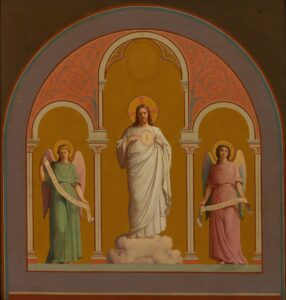
God knows that in spite of His repeated offer of grace, we sometimes do fall. That is why today’s Gospel brings to us the parables of the lost sheep and the lost drachma, both of which precede that of the Prodigal Son (Luke 15), and both of which are providential complements to the feast of the Sacred Heart that we just celebrated. When we fall, the mercy of God is offered to us; it is there for the asking. We must therefore never give in to despair, as if there were no way out. In this life, there is always a way out, because the Sacred Heart of Our Lord, the Good and Eternal Shepherd, is running after us, tracking us down, like the Hound of Heaven in Francis Thompson’s famous poem: ‘with unhurrying chase,/ and unperturbèd pace,/ deliberate speed, majestic instancy’. He tracks us down until He finds us, and then, if only we will let Him, He places us on His sacred shoulders, because He knows we are so weak that we cannot walk. He brings us to His holy Church, so that we may be fortified by the potent remedies He acquired for us, His most precious Body and Blood, and nourished with this divine food, may become strong enough to help others along the way.