Trinity Sunday
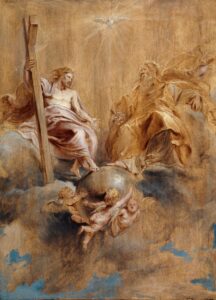
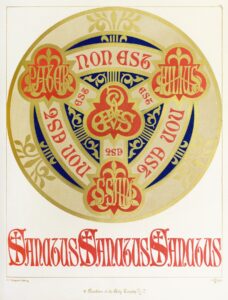
Last night at First Vespers, we sang this antiphon: We give Thee thanks, O God; we give Thee thanks, true and one Trinity, one and most high Deity, holy and one Unity. So much to say that gratitude and thanksgiving are one of the major themes of this feast of the Most Holy Trinity. Having celebrated through the various phases of the liturgical year the manifold interventions of God to save us from eternal perdition, on this day, we halt to give thanks to God considered in Himself as a Trinity of Persons.
There are a few faults that cause more pain than ingratitude. Everyone whose love and support has been requited with indifference, or even betrayal, will know exactly what that means, and it often takes such an experience to help one understand the gravity of the sin of ingratitude. Most of us stop and give thanks to God at meal times. Some of us do so before going to bed. But how many of us live in a habitual spirit of gratitude for the unceasing blessings of which we are the constant beneficiaries? When we stop to consider that not only the air that we breathe and the food that we eat and the clothes that we wear and the roofs over our heads are gifts of God, but our very life and existence itself is the result of a pure, unmerited gift, then we should feel moved to offer thanks to our God for giving us a place in His divine plan and for continually being mindful of us even when, like oblivious little children, we forget Him and carry on as if He did not exist.
Within the grand scheme of things of which every member of the human race is, to varying degrees, beneficiary, each one of us, if we take the time to unfold the various moments of our life, can come to the realisation that every single one of its moments and events, even those that were painful and have left scars, our entire life, every moment of our existence, has been a constant gift of God’s love to us.
When, by the mercy of God, we reach the gates of Heaven, no doubt the first and most overpowering sentiment will be deep regret for that thankless attitude that dominated most of the days of our lives, days that were spent murmuring about what is not working, or grumbling about what has happened, or worrying about the way things are going and what we have to do to make ends meet, instead of glorifying the most Holy Trinity at every moment for so many ineffable gifts.
Often when we discuss the spiritual life, we think of what we must do, how we are to go about growing in holiness and serving God, etc. But what we rarely consider is how much God Himself has been doing, how He has been pursuing us, inviting us into His intimacy, to share His own triune divine life. God’s love for us is always greater. As St John writes: God first loved us (1 Jn 4:19). His longing for us is always more intense than any desire we could have for Him, and its only goal is to draw us into that love and to incite us to love Him in return.
It’s not for nothing that God compares Himself to a disappointed bridegroom, passionately pursuing his bride. The theme is not only found in the Song of Songs, but throughout the prophetic books of the Old Testament. The prophet Hoseah relays these words to us from God Himself:
Behold, I will allure her,
and bring her into the wilderness,
and speak tenderly to her.
… And I will betroth you to me for ever;
I will betroth you to me in righteousness and in justice, in steadfast love, and in mercy.
I will betroth you to me in faithfulness; and you shall know the Lord (Hos 2:14-20).
We read these words, and they touch us, but then we go off and commit our next act of adultery, giving all our attention to others who do not really love us, who can only give us thrills but cannot make us happy.
God-Trinity had no need of us, and yet, He created us so that we could be drawn into His inner life of communion and love. Each human soul is called to be the bride of Christ. Each one of us is that bride. And just as there are brides who are easily conquered and who do not keep their bridegroom waiting, so there are others who only gradually come to realise the love of which they are the object, and often only after a long time of maturation, are in a position to render love for love. Sadly, there are also passionately loved souls, potential brides, who continue to refuse until death the advances of the one who has cast His eyes upon her, and that love is rejected for good. And God is sad.
The bottom line is this, and let’s never forget it: God-Trinity is pursuing us with an ever-pressing love. The time is short. The great and eternal nuptials are about to begin. Are we prepared? Are we ready? Have we allowed ourselves to be washed clean in the pure waters of the sacraments? Have we donned the pure linen garment that signifies the state of grace? Have we adorned ourselves with precious jewels that symbolise all the virtues and the practice of good works?
Such is our task, our only task really, because at the end of the day, all of creation is just one giant preparation for the wedding feast; it is one great love affair between God and our soul. Let’s make sure we do not disappoint that love, that we do not drift off into futile distractions and abandon the Treasure of the universe.
‘Let the joy of the Lord be your strength (Neh 8:10).
For He alone is the Way worth following,
the Light worth lighting,
the Life worth living,
and the Love worth loving’ (Mother Teresa).