
18th Sunday after Pentecost
In today’s Gospel, we admire Our Blessed Lord healing a paralytic. It is one of the countless miracles He performs with a word. What is peculiar, however, to this healing is that He does not simply take the man by the hand or say a few words of healing, but: Take heart, my son; your sins are forgiven. It was a rather unusual, and let us say astounding, method of procedure. The scribes who were present immediately began to grumble to themselves: This man is blaspheming. Our blessed Lord, who knows all things, perceives their thoughts and confronts them: Why do you think evil in your hearts? For which is easier, to say, ‘Your sins are forgiven,’ or to say, ‘Rise and walk’? But that you may know that the Son of man has authority on earth to forgive sins”—He then said to the paralytic—“Rise, take up your bed and go home.” And he rose and went home (Mt 9:2-7).
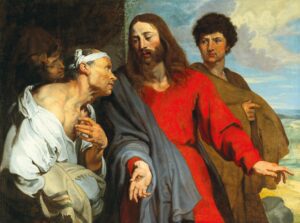
This prodigious healing and the way it was performed raises some questions. In particular, it should get us wondering why Our Lord chose to heal this particular person, a paralytic, with the words: Your sins are forgiven. Let’s begin by saying that He could have said as much to any of the people who came to Him for healing. Indeed, while not all illnesses are directly due to sins – such as people who contract diseases because of committing certain sins – we can certainly say that all evil entered the world through sin and therefore is the consequence of sin. The book of Wisdom makes it clear that death entered the world through the envy of the devil (cf. Wisdom 2:24). In other words, death and all suffering came through sin. So when Our Lord forgives the sin before healing the disease, He is essentially telling us that if we want to be in good health, we need to stop sinning.
But there is more to it than that. Why this particular man? Why a paralytic, that is to say, a man who could not move, whose body did not obey the command of the brain? Quite simply because sin causes spiritual paralysis, that is to say, it removes the soul’s capacity to be supple and flexible under the influence of grace. To be in sin is to be in a state of hopeless rigidity. It is to be frozen, as it were, in evil, without being able to change anything, without being able to get out. This makes perfect sense, because sin is the rejection of the love of God made manifest in His creating us and endowing us with a nature that has its own laws. To trample upon those laws is, in its very essence, to turn one’s back on the eternal good that God is offering us, and attach oneself to a particular good that we prefer to Him. It is to become fixated on a creature and to lose the Creator. It is therefore no surprise that this paralytic hears Our Lord say to him: Your sins are forgiven. Because if your sins are forgiven you, that means that you are released from the enslavement of vice; you are set free from the prison you had locked yourself in. You are now free to move around again, to admire God’s transcendent plan, to embrace it and to discover the infinite vistas of love and eternal freedom He has destined for us.
Another image that Holy Scripture uses for sin is the hardened heart, the heart of stone (cf. Ez 11:19). Sin causes this sclerosis because it turns all our attention on a tiny creature and away from the eternal Creator. What a terrible exchange! What an awful deal! To choose a creature that makes us hard as stone and to lose the Creator who offers us the freedom of the sons of God.
St Paul also uses the image of the “old man” (cf. Rm 6:6) to refer to the life of sin in our souls. We all know very old persons who are so feeble and so fragile. We are afraid they will fall because if they do, their bones will break. They are stiff and, to a certain extent, on the way to paralysis, which will come when they die. Do we not speak of rigor mortis to describe the state of a corpse that has lost all suppleness?
On the other hand, the man who lives according to grace is like the young person who is renewed in strength and in flexibility. As St Paul writes to the Corinthians: So we do not lose heart. Though our outer nature is wasting away, our inner nature is being renewed every day. For this slight momentary affliction is preparing for us an eternal weight of glory beyond all comparison, because we look not to the things that are seen but to the things that are unseen; for the things that are seen are transient, but the things that are unseen are eternal (2 Cor 4:16-18).
All this, of course, makes no sense to the sinner who imagines that by doing as he pleases he is actually free. He convinces himself that by disregarding the laws of his nature he will be able to go here and there and not be bound by any constraints. Ah, but there is the rub. By refusing God’s law of freedom, he subjects himself to the cruel law of sin that begins by enticing and offering happiness, but very quickly has only disgust to offer and leads to slavery which incapacitates in the very faculties God has given us to grow in.
Fortunately, the grace of conversion is offered by the patience of God. Yesterday’s Gospel began with this parable: A man had a fig tree planted in his vineyard; and he came seeking fruit on it and found none. And he said to the vinedresser, Lo, these three years I have come seeking fruit on this fig tree, and I find none. Cut it down; why should it use up the ground? And he answered him, ‘Let it alone, sir, this year also, till I dig about it and put on manure. And if it bears fruit next year, well and good; but if not, you can cut it down (Lk 13:6-9).
God, the eternal gardener of our souls, seeks to restore the life that we had forfeited. He sends labourers to dig up the hard ground around our souls. It might be a friend encouraging us to spend less time amusing ourselves and more time praying. It might be a wonderful story of someone else’s conversion that lights a spark in our heart and makes us wonder: If they did so, why not me? It might be the reminder of the brevity of life and the eternity that awaits us, and the longing to be with God, to be freed from the shackles of the barren sinful life we have led. Whatever the thought, whatever the instrument, it is for us to let that hard ground be dug up, to take the blows that might hurt, but only for a while. Soon, very soon is born that peace that the introit sang about, that peace which is reserved for those who wait for God, who trust in His grace and who know with absolute certainty that God never abandons those who seek Him.
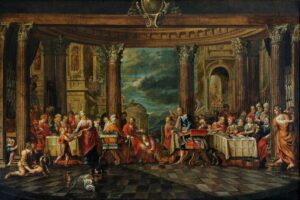
A marvellous example of this was given to us this past Ember Friday in the person of the patron saint of penitents, Mary Magdalene. She was one of those hardened sinners who had thought to find freedom in giving herself to a carefree life of vice. What she had found instead was a life of slavery in which no one really cared about her. She was trapped in sin and could not get out. By the grace of God, she one day heard of Jesus of Nazareth, of His wonderful teaching and stupendous miracles. Hope of the impossible is born in her soul. Divine grace sets to work on that hardened heart, and she is softened. She knows that there is only one way out, and that is to find her way to Jesus. She could hardly approach the Lord; the apostles would not have allowed it. She takes advantage of a dinner thrown by one of the Pharisees in our Lord’s honour. She cares not what people will think. She enters and approaches Our Lord. She kneels down and begins to shed abundant tears upon His sacred feet, drying them with her hair and kissing them. As the prophet Ezekiel had foretold, the heart of stone was taken from her, and a heart of flesh was given her, a heart that would henceforth weep for her many sins. Her youth was renewed; the old stiffness of her sins was gone in an instant, washed away by that flood of tears.
Mary Magdalene went on to become one of the greatest saints, and in so doing gave us all the firm confidence that it does not matter what our past was like. If only we let grace achieve its prodigies in our souls, we too can become saints. If only we let the eternal youth and suppleness of purity and humility attract us to its ineffable delights, only God can tell to what heights of holiness it will lead.