21st Sunday after Pentecost
The great theme of this Sunday is that our life in this world is essentially a time of spiritual warfare, where the enemies are not our fellow humans, but the demons who are fighting against our souls, striving to take us into their eternal reprobation in hell. That warfare goes on until death; it is never finished until then; the enemy strikes blows, as the offertory verse reminds us he did against Job, all with a view to pushing us over the edge of despair so that we will curse God and lose the fight for our own souls. Throughout the battle, we know, as the introit reminds us in the magnificent words of Mardochai, that the Lord is in control of all things, that nothing — literally nothing — can happen without His permission, and that if something bad does happen to us, it is because He allowed it for our own good. Even if we do not understand now, we will later.
Even when in our lives we find ourselves up against the efforts of other human beings to thwart our plans, and even when they do positively seek to hurt us, we must never forget that all this is ultimately not a battle for this world. It is not even a battle for the most important and sacred values of human life, such as family, health and country. All those things are important, but the real, decisive battle that is going on is a battle for our soul, and our soul is the only thing we can never afford to lose. We can lose our health, our job, our family, our reputation, even our life; we must never lose our soul, for we have only one, and if that is lost, all is lost.
As one great saint said:
Remember that you have but one soul;
that you will die but once;
that you have but one life, which is short,
that there is but one glory, which is eternal;
and thus you will be detached from many things.
May your desire be to see God;
your fear, to lose Him;
your sorrow, to not yet possess Him;
your joy, in what can lead you to Him,
and thus you will live in great peace.
Or as an old poem has it:
Life is short and death is sure,
The hour of death remains obscure.
A soul you have, and only one,
If that be lost, all hope is gone.
Waste not your time while time shall last,
For after death ‘tis ever past.
The all-seeing God your Judge will be,
And Heaven or Hell your destiny.
All earthly things will pass away;
Eternity… alone will ever stay.
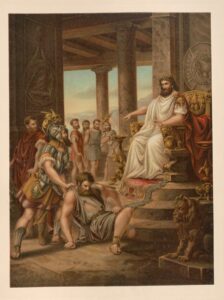
That is precisely why the parable of the unforgiving servant is an essential part of this Mass. The war is not against others, even when we have to strive against the injustice of which we may be victims. The war is for souls, and the soul of whoever hurts me must also be dear to me. The truly Christian soul never writes anyone off, but strives to save all, even those who hurt us, who cheat us, who subject us to injustice. And the most effective means we have at our disposal is to forgive them for what they have done to us. The Lord makes it clear that if we don’t forgive them, He won’t forgive us. Why would He? Our debt to Him is infinite; our enemy’s debt to us is finite. If He forgives us, so must we forgive them.
Now let’s take a closer look at St Paul’s recommendations to the Ephesians. He tells them, and through them he tells us, to be strong in the Lord and to arm ourselves defensively. He enumerates: armour, belt, breastplate, boots, shield and helmet. Truth is the belt that girds our loins; like a belt that holds together our clothing and gives us assurance and freedom to act, so the truth secures the soul who is in its possession in such a way that it is not afraid to confront error. Justice, that is to say, holiness, is the breastplate that protects our heart and all its affections, and which invigorates us to stand firm and face the enemy. The peace of the Gospel is the footwear with which we are shod, for it grounds us in the firm certitude that comes from knowing that Christ shed His blood to establish peace in our hearts, and therefore, we must never run away. Faith is the shield that wards off the fiery arrows of temptations that assail us at every moment, for it alone allows us to put everything that happens to us or to the world in the proper perspective of eternity. The hope of salvation is our helmet, which points us continually upward and keeps us sane and confident even as the enemy pummels us with his assaults.
Christians, however, do not just stand there and take blows because they are protected by God. No, they have a weapon, the most formidable of all weapons. It is a sword, the sword of the Spirit, which is the Word of God. The Word of God is a sword which, as we read in the epistle to the Hebrews, is “living and effective, sharper than any two-edged sword, penetrating even between soul and spirit, joints and marrow, and able to discern reflections and thoughts of the heart” (Heb 4:12). The Word of God cuts deep into people’s hearts. Even if they may appear to reject it or not feel concerned, even if they may give no sign of having been influenced by it, it does reach the heart, and it will speak to them at the very moment they are able to receive it. Many, of course, reject the Word; it falls like seed on a stony path where the birds come and eat it up, or it falls among thistles and thorns that suffocate it. It is up to us to ensure that our little garden is free of weeds and that the soil is fertile.
The worker of the Gospel must never tire of speaking the truth. That is precisely why St Paul adds in the two verses which follow today’s epistle: “Pray for me, that speech may be given me, that I may open my mouth with boldness, to make known the mystery of the gospel, for which I am an ambassador in chains: so that therein I may be bold to speak according as I ought” (Eph 6:19-20). It is comforting to read that the great apostle himself relied on the prayers of his sons and daughters in the Lord. Preaching with the sword of truth is a daunting task. Many meet with opposition, persecution, prison and death. The enemy of God hates the truth, and those who serve the devil detest those who speak God’s truth. That is why we must pray for those who have that task, that they be strong, that they never fail, for many do. They can bind me, writes St Paul to Timothy, but they cannot bind the word of God (cf. 2 Tm 2:9). If they get rid of me, others will rise in my place. The blood of martyrs is the seed of Christians.
All things are in Thy will, O Lord, and there is none who can resist Thy will, for Thou hast made all things; Thou art Lord of all. Let us hope then in the Word of the Lord, under the mantle of Mary Immaculate, holding in hand that other great weapon she has given us, the Holy Rosary, through which the Word of God is ever on our lips and in our hearts, making us to resist all evil and stand perfect before God and men. Amen.