
20th Sunday after Pentecost
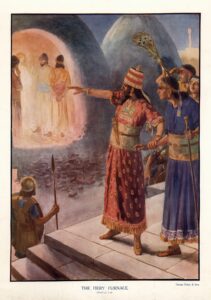 Today’s Mass opens with a passage from the prayer pronounced by Azariah in the burning furnace. The episode is set during the Babylonian captivity, when the Chosen People had been exiled into a foreign land and deprived of the Temple and its sacrifices. Things were bleak; they were tragic. The prayer is one of great humility, acknowledging that the people only received what they deserved. Abandoning God and His law, living like pagans, no wonder they were chastened and deprived of the most sacred worship that had been committed to them as their most precious heritage.
The words of this prayer are worth quoting at length. They ring true in our age as well, as we look out over the devastated civil and religious landscape of our times:
Blessed art thou, O Lord, God of our fathers, and worthy of praise;
and thy name is glorified for ever.
For thou art just in all that thou hast done to us,
and all thy works are true and thy ways right,
and all thy judgments are truth.
Thou hast executed true judgments in all that thou hast brought upon us
and upon Jerusalem, the holy city of our fathers,
for in truth and justice thou hast brought all this upon us because of our sins.
For we have sinfully and lawlessly departed from thee,
and have sinned in all things and have not obeyed thy commandments;
we have not observed them or done them,
as thou hast commanded us that it might go well with us.
So all that thou hast brought upon us,
and all that thou hast done to us,
thou hast done in true judgment.
Thou hast given us into the hands of lawless enemies, most hateful rebels,
and to an unjust king, the most wicked in all the world.
And now we cannot open our mouths;
shame and disgrace have befallen thy servants and worshipers.
For thy name’s sake do not give us up utterly,
and do not break thy covenant,
and do not withdraw thy mercy from us,
for the sake of Abraham thy beloved
and for the sake of Isaac thy servant
and Israel thy holy one,
to whom thou didst promise
to make their descendants as many as the stars of heaven
and as the sand on the shore of the sea.
For we, O Lord, have become fewer than any nation,
and are brought low this day in all the world because of our sins.
And at this time there is no prince, or prophet, or leader,
no burnt offering, or sacrifice, or oblation, or incense,
no place to make an offering before thee or to find mercy.
Yet with a contrite heart and a humble spirit may we be accepted,
as though it were with burnt offerings of rams and bulls,
and with tens of thousands of fat lambs;
such may our sacrifice be in thy sight this day,
and may we wholly follow thee,
for there will be no shame for those who trust in thee.
And now with all our heart we follow thee,
we fear thee and seek thy face.
Do not put us to shame,
but deal with us in thy forbearance
and in thy abundant mercy.
Deliver us in accordance with thy marvellous works,
and give glory to thy name, O Lord!
Let all who do harm to thy servants be put to shame;
let them be disgraced and deprived of all power and dominion,
and let their strength be broken.
Let them know that thou art the Lord, the only God,
glorious over the whole world (Dan 3:27-45).
These words, each of us can apply them to himself. We have all, through our sins, turned our back on God and broken faith with Him. Because of it, we have found ourselves desolate, distraught, hopeless. But God does not refuse a contrite and humble heart. He is always ready to welcome the repentant soul that returns to Him.
But the prayer is also applicable to the Church. The Church of the New Testament remains subject to the same temptations as the Synagogue. The enticement of pleasures and power, the thrills of false worship, and vain and novel teachings can ever be a stumbling block today as they were then. As a Church, there are times when we fail the Lord. There are dark moments in history when all but a few let themselves be corrupted by a pagan mentality. And then we are handed over to leaders whose faith is weak, if it exists at all, whose teachings are like empty cisterns that cannot slake the thirst of the people. There are times when the most sacred aspects of our worship are denied, when access to the life-giving source of grace, which is the sacraments, is very difficult or even refused. In those times, our only recourse is to humble, persevering prayer, striking our own breasts, and not those of those who hurt us.
It can happen that we become discouraged. Individuals can lose hope in their own conversion; the Church herself can wonder if ever the tide of evil will be overturned. We must never doubt. We must believe. St John tells us in his first epistle: We have believed in the love God has for us (1 Jn 4:16). It is an act of faith. We must believe in His merciful love. It is our only hope. True, we do not deserve consolation; true, we can appeal to no act of justice of our own; we have none. But we can appeal to His mercy and it is upon this that we must rely, in spite of everything, in spite of our broken resolutions, in spite of our intermittent efforts, in spite of temptations which arise and sometimes overcome us, in spite of inertia, dryness, distaste for prayer, in spite of the daily tasks which sometimes overwhelm us, in spite of our companions along the way who are sometimes a severe trial, in spite of the fact that God seems so far away, in spite of failing health, in spite of the losses caused by death, in spite of circumstances which seem to conspire against us, in spite of the terrible struggles the Church has to endure and the apparent setbacks to God’s reign.
The centurion in today’s Gospel gives us an example. He was a pagan; he did not deserve Jesus’ attention, much less a positive reply. But he believed. He had not seen, but he had believed, and he was answered. So shall it be with us if we can only believe in God’s love for us.
The days are evil, St Paul tells us in today’s epistle. To tell the truth, we didn’t really need the reminder. But those days, that time, can and must be redeemed. It must be bought back. And with what shall we pay for it? We have nothing of ourselves. All that we have of ourselves is apt to only increase our punishment. And so let us have recourse more and more to that merciful love of the Sacred Heart of Jesus which is offered to the humble of heart, to the intercession of Mary Immaculate, the Mediatrix of all Grace.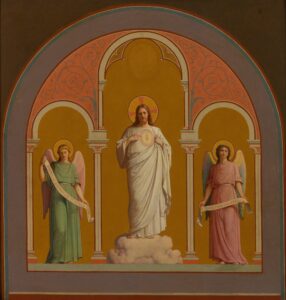
In a few moments we will chant this verse from Psalm 136: Upon the rivers of Babylon, there we sat and wept when we remembered Sion. And so do we. We sit, and we weep as we consider the glories of our heritage, and realise where we are now. We weep, but we know that our tears are not fruitless, for the Lord sees them, He collects them, and when there are enough of them to fill the vial, He will step in; He will one day send us a great leader to restore all things, one who will not be afraid to stand up against the wolves of the modern Babylons, who will expose himself to save his sheep.
It is a perilous thing to attack God’s people, as so many have experienced throughout the centuries, for God does not abandon those who are His. He punishes them, yes; He lets the yoke of the enemy weigh heavily upon them, yes; He puts them to the test, yes; He wants them to repent and come back to Him, yes; but He does not abandon, and He does not break His Covenant, and in the end He restores and gives victory, His victory, that He will share with all those who trusted Him in spite of everything.
Thus saith the Lord God the Holy One of Israel: If you return and be quiet, you shall be saved: in silence and in hope shall your strength be (Is 30:15). Yes, it is good to wait with silence for the salvation of God (Lam 3:26).