
6th Sunday after Pentecost
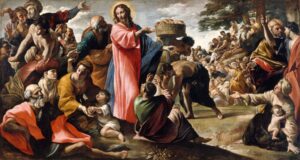
Today’s Gospel presents us with the multiplication of loaves as recounted by St Mark. The crowds were so enthralled by the preaching of Our Blessed Lord that they had followed Him for three days in the desert. They had not taken time to prepare food, and so by now they were famished and exhausted. Let’s stop for a moment to admire, on the one hand, the fascination of Our Lord’s preaching that was able to draw so many souls to a location that held nothing desirable for nature, and on the other hand, the docility and eagerness of the crowd that let itself be drawn by grace. We are reminded of Our Lord’s word: No one can come to Me unless My Father draws him (Jn 6:44). These souls were certainly drawn by grace, and they were amply rewarded for their fasting.
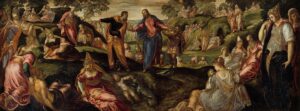
The miracle of the multiplication of loaves holds within itself a number of points of consideration, but for today, rather than focusing on the miracle itself, let us consider its context in the Gospels. By looking at the place a particular event has in the Gospel, we are sometimes led to see it from a different angle and can better understand some of its implications. Matthew, Mark and John all place the multiplication of the loaves immediately before the request for a sign. The fact itself is quite surprising. Our Lord has just performed a stupendous miracle by feeding several thousand people with just a few loaves and fish, and they are asking for a sign! What can this mean? Do you not know a sign when you see one? It is true that the request comes from the Pharisees, who are asking for a sign from heaven. We can suppose they were hoping to see one of the prodigies they had read about in the Old Testament, such as when Elijah called down fire from Heaven. In St John’s Gospel, they go so far as to remind Our Lord of the sign of the manna in the desert that lasted 40 years, as if to say: ‘What you have just done Moses did for 40 years in a row; you need to do better!’
This attitude shocks us, and it should. It demonstrates a hardness of heart that should frighten us. To see with your own eyes a miracle that cannot be denied, and to not be touched by it, to at least stop and think, implies a degree of pride and blindness that has no excuse. How can we explain this hardness of heart? One of the reasons, as Our Lord himself points out on several occasions, is that the Pharisees had grown so attached to the many ritual minutiae of the Old Covenant, many of which they had added on themselves and were not in the Law itself, that they left aside the weightier commandments of mercy and fraternal charity. In modern parlance, we would say that the liturgy had become so primordial for them that they were oblivious to the needs of the poor. The entire faith was about liturgy, whereas liturgy in reality is only part of the faith. For them, the faith is all about performance, facade, making an impression on others and, above all, holding tight to their position of influence. St John also tells us of another fatal vice: Though Jesus had done so many signs before them, yet they did not believe in Him…. For they loved the praise of men more than the praise of God (Jn 12:37-43).
Because of this inversion of priorities, they could not understand what the Lord tried so hard to get across to them, namely that He has come to initiate the definitive revolution in human history, the one that goes from a religion of externals to a religion of the heart. To the Samaritan woman, who was very flustered about whether one should worship in Jerusalem or on Mount Gerizim, Our Lord says: Woman, believe me, the hour is coming when neither on this mountain nor in Jerusalem will you worship the Father…. The hour is coming, and now is, when true worshipers will worship the Father in spirit and in truth, for such the Father seeks to worship Him. God is spirit, and those who worship Him must worship in spirit and in truth (Jn 6:21-24).
Even the apostles needed time to catch on to what was happening. Immediately after the request for a sign, Mark tells us of another episode that, in some respects, may appear insignificant, yet is intimately linked to this whole question. The apostles had gotten in the boat with Our Lord and had forgotten to bring bread. Our Lord then says to them: Take heed, beware of the leaven of the Pharisees and the leaven of Herod. Thereupon, the disciples start debating what this meant, and they come to the conclusion that the Lord was complaining that they had forgotten the bread. It is then that we encounter one of those moments in the Gospel where Our Lord shows that He is truly human, for He cannot refrain from showing His frustration: Jesus said to them, Why do you discuss the fact that you have no bread? Do you not yet perceive or understand? Are your hearts hardened? Having eyes do you not see, and having ears do you not hear? And do you not remember? When I broke the five loaves for the five thousand, how many baskets full of fragments did you take up? They said to him, Twelve. And the seven for the four thousand, how many baskets full of fragments did you take up? And they said to him, Seven. And he said to them, Do you not yet understand? (Mk 8: 15-21). The Lord’s frustration comes from the fact that, even though they, the apostles, had seen more signs and wonders than anyone else, they were still enmeshed in their earthly considerations as if Our Lord could not provide for all their needs. They had not yet come to realise the essence of the New Law which we meditated on last week: the sign, the only sign given to the world, is that we must love one another. That is the sign that makes Christianity new and eternal and sets us apart.
We can ask ourselves: Do we understand? How many times does Our Lord have to repeat the same things over and over again for us to get it? How long will we remain on the surface of things, giving excessive importance to details, while we leave aside the more weighty commandments of the law? Are we sure we do not deserve Our Lord’s reproach: Woe to you, scribes and Pharisees, hypocrites! for you tithe mint and dill and cummin, and have neglected the weightier matters of the law, justice and mercy and faith; these you ought to have done, without neglecting the others. You blind guides, straining out a gnat and swallowing a camel! (Mt 23:23-24)
How are we to avoid this condemnation? How are we to be among those who adore in spirit and truth? The answer is given in today’s epistle. St Paul is writing to the Romans and explaining how the Mosaic Law and its multiple observances cannot bring one to holiness. There is only one way to become holy, and that is by being grafted into Christ Jesus. If we have been united with Him in a death like His, we shall certainly be united with Him in a resurrection like His (Rm 6:3-5).
There is no other path to glory, no other way to holiness, no other way to be a true follower of Christ than to live the way He did and die the way He did. It means going out into the desert with Him, accepting to suffer, to fast, to be deprived, to wait, to endure, to listen, to forgive, above all, to love, especially those who hurt us, who cause us trouble, who force us out of our mediocrity, who challenge us to practice what we preach. If we learn that lesson, if we are able to die to ourselves, then we have truly learned who Jesus is, what His religion is about, and we can truly be a sign for a generation that needs more than anything else to see that the disciples of Christ are one and are ready to die for one another, and even for their enemies. Then the sign will be clear, and Our Lord’s prayer made at the Last Supper will have been answered:
I pray for those who believe in me, that they may all be one; even as Thou, Father, art in me, and I in Thee, that they also may be in us, so that the world may believe that Thou hast sent me (Jn 17:20-21).