
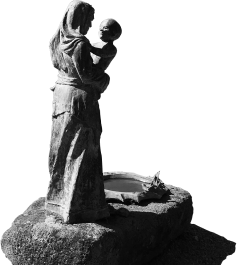
Immaculate Conception
By virtue of the Immaculate Conception, Our Blessed Mother is in her own category. She is not God, nor is she just one of us; she is not even just the best of us. She is apart. True, she was redeemed by her Son, but in a unique way, that is to say, pre-emptively, in such a way that the Original Sin which stains every son and daughter of Adam and Eve and makes them a sinner from the get-go, did not even approach her pure soul. This unique grace was granted her by virtue of the merits of her Son that God foresaw in time and by which He set a limit to the power of sin over the human race. She alone, ‘our tainted nature’s solitary boast’ (William Wordsworth), stands erect amidst the fallen; she alone is all pure, all holy.

Why did God work this prodigy that we contemplate in loving admiration on this day? It was not because God plays favourites. Even though He has every right to grant certain souls graces that are not given to others, when He does this, it is for a purpose, a mission, He gives that soul. So why did He want Mary to be immaculate? The only way to answer this question is to ask why God became incarnate; the answer is that this was His chosen means of redeeming the human race. Since, therefore, the Virgin was going to be the means by which redemption comes to us, it is for this reason that she is immaculate. A man and a woman united to cause our downfall in the Garden of Eden. God, therefore, decreed that a man and a woman would concur to save us. In other words, when God became incarnate in Jesus, He wanted to have a woman as His helper, His co-worker, so that the redemption of the human race would be effected by both a man and a woman. To be sure, their cooperation is not of the same kind. Jesus Our Lord is the sole redeemer of the human race. He alone, as the God-Man, could repair what was broken, restore what had been stolen.
There is one Mediator between God and men, Christ Jesus (cf. 1 Tm 2:5), but Our Lord wanted to have what we can and do call secondary mediators, that is to say, persons who take part in bringing men to God by disposing them to receive grace and being the ministers of the distribution of that grace (cf. St Thomas, Summa Theologiae, IIIa, 26, 1). St Paul clearly teaches this doctrine when he frequently encourages the faithful to pray for him and when he promises to pray for them. What else is this but to play the role of mediators for each other? Each of us can become the minister of God’s grace, cooperating with Christ by interceding and suffering for the salvation of some individuals. Still, Mary cooperates uniquely, not just for some individuals, but for all of humanity.
She did this in three different phases of her existence. The first is by being the intermediary between God and man in the very act of the Incarnation. This is the mystery we contemplate at Christmas. God came to us through Mary, and without her, He would not have come. This is why St Bernard portrays the angels waiting in suspense for Mary’s Fiat at the Annunciation: our salvation was literally dependent upon her accepting to be the Mother of God. All grace therefore comes to us in Christ through her by the very fact that she conceived in her womb and gave birth to the Saviour.
The second phase of her unique cooperation is standing at the foot of the cross. Although many others were present, she alone knew what her Son was accomplishing on Calvary; she alone united herself with that sacrifice; she alone adhered to the redemptive sacrifice of her Son with all the faculties of her soul and body. The devotion to our Mother of Sorrows is based on this unique participation in the redemption by which she merits to be called co-redemptrix. St Pius X, in the Encyclical Ad Diem Illum, published for the 50th anniversary of the proclamation of the dogma of the Immaculate Conception (1904), declared that: ‘since Mary carries it over all in holiness and union with Jesus Christ, and has been associated by Jesus Christ in the work of redemption, she merits for us de congruo (or congruous merit, that is to say, as a fitting distinction granted because of her intimate union with the Saviour), what Jesus Christ merits for us de condigno (or condign merit, that is to say by virtue of strict justice)’. This is the meaning of the consecrated expression co-redemptrix, by which we do not mean that Mary accomplishes our redemption by doing half the job that Jesus could not do, but rather, that Jesus works the entire redemption with Mary’s free, irreplaceable and sacrificial cooperation.
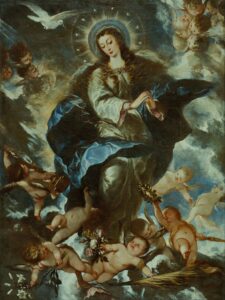
The third phase is in the dispensation of the graces merited on Calvary by her Son. By means of her intercessory prayer now in Heaven, she draws the will of her Son to distribute these graces in abundance, not only on individual souls, but on all of humanity. The source of these graces is Christ alone, but Mary presides over their distribution. This is why several magisterial documents of the Church (including Vatican II) refer to her as the mediatrix, the one through whom the grace of Christ reaches the world. St Pius X concludes the quotation we just saw with these words: ‘Mary is the supreme Minister of the distribution of graces’, by which we mean that all graces granted to any member of the human race pass through her immaculate hands.
This is the pure Catholic teaching on Our Lady’s unique place in the mysteries of our holy faith, and we are now in a better position to understand the mystery we honour today. Her Immaculate Conception prepares her and makes her able to be that co-worker with Christ, to become our Mother in the order of grace. We can also see better now why the refusal to grant Mary her proper titles or to make the effort to understand them properly cannot be pleasing to the God who called her. It is why every true Catholic nurtures not only a tender love for Mary, but also a fierce defence of her privileges.
It seems appropriate to add here that the acknowledgment of these privileges is a most powerful response to the demands of radical feminists in the Church. Some want to be priests and bishops. To them, and to all women, we say: lift up your eyes to Mary Immaculate. Behold her splendour, her role at Christ’s right hand, and you will find no greater model to imitate. Behold Mary Immaculate, pure, chaste, humble, poor, detached from all creatures. Through woman man is saved: through Mary Immaculate, salvation reaches us. And every woman can take part, at Mary’s side, as her daughter, in saving many souls by means of the oblation of her entire being, body and soul, to Christ, to be the instrument He wills in the salvation of souls. Women are not called to be priests, but they are called to sustain priests through prayer and sacrifice as they hang with Jesus on the cross that saves. Such is the model for every woman who wants to play her modest role in helping souls.
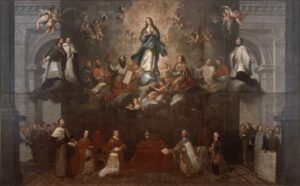
Women have nothing to envy men for. There should be no rivalry between the sexes. Catholicism, more than any religion, acknowledges the unique, blessed and vital role of woman, her capacity to take part in the salvation of souls, just as much as men, and often more. Indeed, the principle of Mary’s congruous merit is the greatness of her love, which is surpassed by none. St Therese of Lisieux understood this when she wrote that in the heart of the Church she would be love. Such is the vocation of every Catholic woman, to be love in the heart of the Church. The more you love, the greater you are. The really great ones are not the ones who preach and teach and administer the sacraments, but the ones who love the most, and women often love more than men. As that love grows, so does the desire to take part in saving souls, with Mary and through Mary, for the glory of Jesus Christ, now and throughout all eternity. Amen.