
Quinquagesima Sunday
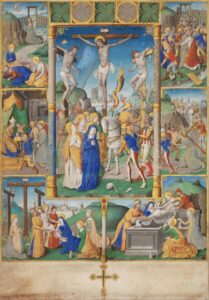
On this final Sunday before the beginning of Lent, Holy Mother Church issues the third clarion call. We have been warned of the arduous task ahead, of the steep mountain we must climb, of the narrowness of the path and the tribulations that await us. Today’s Gospel reminds us that all we must suffer has already been endured by our dear Saviour in His passion, and the fulness of Christian holiness consists only in replicating as closely as possible the heavenly model: We go up to Jerusalem and the Son of Man will be rejected, mocked and crucified, and on the third day will rise again (Lk 18:31-33). This is a hint from Mother Church that we should focus now on contemplating the passion of the Saviour, for we will find therein all the treasures of grace of which we stand in need.
Simultaneously, an essential word of advice is given to us by St Paul with the hymn to charity. He insists that it does not matter what we might be able to do or endure, if we do not accomplish it with true love of God and neighbour, it is pointless and will win no reward. The hymn to charity reminds us that, over and beyond the ephemeral goods of this fleeting life, there are values that remain, there is Someone that remains. And the way we gain access to this Someone and to the higher life to which we are called are the theological virtues of faith, hope and charity. These virtues, which are infused by God, take us into an entirely new realm, one in which we take part in the very life of God. Through faith, we believe everything He has revealed about Himself, as it is contained in Holy Scripture and in Tradition and taught authoritatively by the Holy Catholic Church. Through hope, we have absolute confidence in the help of God, who wants to forgive us our sins when we repent of them, and give us eternal life. Charity (agape, that is to say, the selfless love of oblation that seeks not itself but the beloved) is the greatest of the three. St Paul gives us the fundamental reason for this when he says at the end of today’s epistle that faith and hope will no longer exist in Heaven, for their object will have been attained: we will not need to believe God on faith for we will see Him as He is; we will not need hope in His grace, for we will have obtained the very object of that hope; but love will ever remain, it will never pass, it is actually the very heart and core of eternal life, for God created us for this very purpose of sharing with us His eternal love. God is love, St John tells us in his first epistle, and St Paul tells us today that this love, this one love – for really there can be only one true love – is endowed with a number of characteristics which stem from the very nature of true love. So what is that nature? To love is to seek the good of the person loved. To love is to put others first – God before all others – and self last.
In the first three verses of today’s epistle, the apostle, thanks to a triple repetition, hammers home the fact that it does not matter how marvellous might be the things we do in this life; if we do not have supernatural charity, it avails nothing: He writes: If I speak with the tongues of men and of angels, and have not charity, I am become as sounding brass, or a tinkling cymbal. And if I should have prophecy and should know all mysteries and all knowledge, and if I should have all faith, so that I could remove mountains, and have not charity, I am nothing. And if I should distribute all my goods to feed the poor, and if I should deliver my body to be burned, and have not charity, it profiteth me nothing (1 Cor 13:1-3). To speak all the languages of the world, to solve all its problems – political, social, religious even –, to even use up all one’s energy and resources to make the world a better place: all this is of no avail if the love of God does not reign in our hearts.
The apostle then proceeds to enumerate the characteristics of charity, beginning with: Love is patient, and concluding with: love endureth all things, almost as if to place the virtue within the realm of one’s capacity to suffer with others. What is patience, indeed, if it is not the ability to suffer? One will never repeat too often nor meditate without fruit the fact that patience and passion have the same Latin root. Pati means to suffer, and it has given both the word passion (as in passion or sufferings of Christ) and patience. It is through patience that we learn to suffer with profit for our souls. How vital is this virtue in daily life! St Paul tells us today that it is precisely charity which inspires patience. And this is why it is significant that he concludes the series of four verses on the characteristics of charity with: Love endureth all things. Yes, when you love, you are prepared to bear all burdens for the one you love; nothing is too heavy, too burdensome.
One of the most beautiful commentaries on this verse has to be ch 5 of the third book of the Imitation of Christ, on the wonderful effects of divine love, from which I borrow these lines: “Love is an excellent thing, a great good indeed, which alone taketh light all that is burdensome and equally bears all that is unequal. For it carries a burden without being burdened and makes all that which is bitter sweet and savoury. The love of Jesus is noble and generous; it spurs us on to do great things and excites us to desire always that which is most perfect… Nothing is sweeter than love; nothing stronger, nothing higher, nothing more generous, nothing more pleasant, nothing fuller or better in heaven or on earth; for love proceedeth from God and cannot rest but in God above all things created. The lover flies, runs and rejoices, he is free and not held. He gives all for all and has all in all, because he rests in one sovereign good above all, from whom all good flows and proceeds. … Love often knows no measure, but is inflamed above all measure. Love feels no burden, values no labours, would willingly do more than it can; complains not of impossibility, because it conceives that it may and can do all things. It is able therefore to do anything and it performs and effects many things where he that loves not faints and lies down. Love watches, and sleeping, slumbers not. When weary is not tired; when straitened is not constrained; when frightened is not disturbed, but like a lively flame and a torch all on fire it mounts upwards and securely passes through all opposition… Love is swift, sincere, pious, pleasant, and delightful; strong, patient, faithful, prudent, long-suffering, courageous, and never seeking itself. For where a man seeks himself there he falls from love. Love is circumspect, humble, and upright, not soft, not light, not intent upon vain things; is sober, chaste, stable, quiet, and keeps a guard over all the senses”.
This marvellous doctrine is destined to lift up our minds and hearts to heavenly realities, but we all know the pull of the flesh to bring us back down. The example given to us today by the blind man of Jericho should inspire us. He hears that Jesus is passing, and begins to shout: Jesus, son of David, have mercy on me. And they that went before, rebuked him, that he should hold his peace: but he cried out much more: Son of David, have mercy on me (Lk 18: 38-39). This insistence on prayer is a model for us all. When the world seeks to bring us back into its clutches, when the flesh clamours for excessive or undue attention, when we feel our own weakness, let us cry out the louder: Son of David, have mercy on me. If we do so consistently, Our Lord will, through the intercession of Mary Immaculate, Mediatrix of All Grace, give us an increase of divine love, that love which will give value to all the penances and mortifications of the holy season of Lent – and please God, they will be many and fervent. As the ashes are imposed on our foreheads this Wednesday, we are reminded of the frailty of this passing life and its meaninglessness if it is not spent in loving God and, out of love for Him, loving neighbour. In the words of St Elizabeth of the Trinity: “We see the true value of things by the light of eternity. Oh, how empty all is that has not been done for God and with God! I beg you to mark all your doings with the seal of love; it is the only thing that lasts! …”