
Sunday within the Octave of Christmas
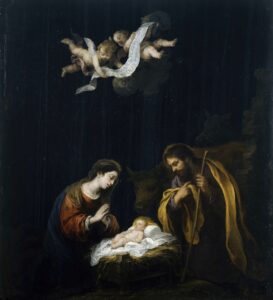
While all things were in quiet silence, and the night was in the midst of her course, Thy almighty Word O Lord, came down from heaven from Thy royal throne (Wisdom 18:14-15). These words, which we sang at the beginning of today’s Mass, referred in the book of Wisdom to God’s intervention to save His people from Egypt. He sent His word in the middle of the night to strike with death the firstborn of the Egyptians and lead His people to peace. Centuries later, in the fullness of time, it is likewise in the middle of the night that the Word of God incarnate came down in the form of a tiny babe, not to intimidate and to kill but to bless and to save.
Why does God want to remind us that His visits are often in the silence of the night? We can safely say that it is one way of making it clear that it is not by human initiative or craftiness that salvation comes. When men perform feats, they often do so with a profusion of noise that seeks to manifest their pride in themselves (think of how warriors in ancient times would arouse themselves by making a terrific din in order to intimidate the enemy, whereas nowadays we need only press a button to set off loud and deadly explosions). God, however, does not need that show of strength. God does not need to arouse Himself to act. God does not need to intimidate. God is almighty, and by intervening when all is in silence and without any prelude, He makes it clear that He is in control. Furthermore, it is most often in silent prayer that God makes His will known to the pious soul. This is why it is so important that we all have some quality silent time each day to commune with God, to speak to Him from our hearts, and to listen to what He has to tell us.
This reality also has profound consequences on the sacred liturgy. Almost everyone is aware that in the traditional rite of the Mass, the heart of the Mass, that is to say, the Canon, is recited in silence. There are many reasons for this. We can enumerate a few: 1) The consecration and sacrificial act are exclusively priestly functions, and therefore, it makes sense that the priest speaks those words to God in silence. 2) It harmonises with the essence of the mystery through which the material elements are changed silently without the senses perceiving it. 3) Silence betokens awe; when a person is in awe, they usually manifest it by an incapacity to speak. 4) The silence veils the sacred words in mystery and withdraws them from being profaned with the tone of ordinary discourse. 5) The silence mystically represents Christ praying in silence during His agony.
For all these reasons and more, the heart of the Roman Mass is surrounded by a reverential silence in which even the priest seems to disappear before the majesty of God. Even one of the greatest promoters of liturgical reform in the 20th century, Fr Josef Jungmann, wrote in his monumental work on the Mass of the Roman Rite: ‘The priest enters the sanctuary of the canon alone… A sacred stillness reigns; silence is a worthy preparation for God’s approach. Like the High-Priest of the Old Testament, who once a year was permitted to enter the Holy of Holies with the blood of a sacrificial animal, the priest now separates from the people and makes his way before the all-holy God in order to offer up the sacrifice to Him’.
This raises a question: when did the Church begin the practice of the silent canon? The simple answer is that we do not know. In-depth studies on the history of the Roman Mass seem unable to furnish us with a single date or place for the introduction of the silent canon, and that, of course, is significant, for it points to a very ancient practice – it is what is called an immemorial custom: no one knows when it began. We can cite an anonymous commentator of the eighth century, who seems to prove that by then the practice was already widespread: ‘A great silence has begun to be observed everywhere; the priest, his mind fixed on God, now begins to consecrate the salutary oblation of the Body and Blood of the Lord… I think the consecration of the Body and Blood of the Lord is always celebrated in silence because the Holy Spirit remaining in the priest secretly performs the effect of the same sacraments’.
Similarly, another author of the same period, Almarius of Metz, who had first-hand knowledge of the liturgy in Rome, writes: ‘It was the custom of our Fathers that those who pray should offer sacrifice to God. Therefore, that which we say in a loud voice before the Te igitur (first prayer of the Roman Canon) pertains to the praise of our Creator… Then follows the Te igitur, namely, the special prayer of the priests… because this prayer in a special manner belongs to the priest, the priest alone enters upon it, and secretly recites it’.
This may remind you of those words of the Imitation of Christ: ‘So great, new, and joyful ought it to appear to thee when thou comest to communion, as if on this self-same day Christ for the first time were descending into the Virgin’s womb and becoming man, or hanging on the cross, suffering and dying for the salvation of mankind’ (Book 4, ch. 2). In other words, every time we attend Holy Mass, we can say we are living Christmas night as Christ comes down in the silence of the canon to become flesh on our altars.
We might ask further: Why is this so important? One of the most fundamental reasons is that God ordinarily communicates His light and grace to the soul in quiet, intimate prayer, and this grace, in turn, is necessary to ward off temptations and to face the challenges that the world presents to our faith. It is noteworthy that if the Child of Bethlehem was born in silence, He was straight away forced to face the hostile forces of evil. The frail babe is born, thrown out literally to the winds. Hardly is He born, a bloody sword hangs over His head. His parents are obliged to take Him by night and run for their lives. Already, He is a sign of contradiction, a threat to the powers that be, as today’s Gospel reminds us. And so will He ever be.
Yes, in every age, the truth of God, His eternal Word, is contradicted by the world and by those who live according to the maxims of the world. But that has never really been a cause of concern for the true disciple of Christ, whose only care should be to commune regularly with the Lord in silent prayer and by devout assistance at the Holy Sacrifice of the Mass, for this will obtain for him the grace to live the Gospel message and to be a witness to the Lord in all circumstances without compromise or ambiguity.
The Christmas season also reminds us that Our Blessed Mother pondered all these events in the silence of her heart. She can teach us the value of silent prayer, and how to dig deeper into that well of unlimited peace, of which the angels did sing: Glory to God in the highest, and on earth peace to men of good will. ‘The God of peace pacifies all things, and to gaze on this stillness is to find repose’, writes St Bernard of Clairvaux (Commentary on the Song of Songs, 23, 16). In returning and rest you shall be saved; in quietness and in trust shall be your strength, says God Himself through the prophet Isaiah (Is 30:15). And David tells us in Psalm 84: I will listen to what the Lord has to say, for He speaks peace to His people (Ps. 84).
‘Peace is truly the gift that Jesus Christ brought us from Heaven. It is a gift that only God can give, so beautiful, so profound, so all-embracing, so efficacious that we shall never truly comprehend it… If we but understood this God-given gift of peace, we could appreciate how it is the synthesis, the very climax, so to speak, of all the graces and heavenly blessings that we have received in Christ Jesus. Peace is the seal of Christ. It is not just one of His many gifts; it is, in a certain way, His own gift… The world, which counterfeits everything, cannot counterfeit peace, however much it tries. It misrepresents joy; the world’s happiness is always superficial and sometimes even bitter. The world counterfeits wisdom, dazzling the credulous with a showy but empty knowledge. It counterfeits love, giving this sacred name to brute passion or to vile egoism. The world, the offspring of Satan, father of lies, is essentially an impostor, falsifying everything. But it is powerless in counterfeiting one thing: peace. The world cannot give peace, because peace is a divine thing; it is the seal of Jesus Christ…’ (Cf. Archbishop Luis Martinez, When Jesus Sleeps).
As we give thanks to God for all the graces of the past year and look forward to a new year of grace, let us never forget that the peace we sing of at Christmas is given only to the humble, the prayerful, those who take care to approach God in silence and who are thus ready for the unexpected ways in which the Prince of Peace enters our lives.