
First Sunday after Epiphany, Holy Family
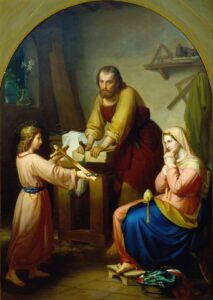
His parents did not know… (Lk 2:43)… They understood not the words He spoke to them (Lk 2:50).
These two sentences from today’s holy Gospel should give us great courage and hope. It should not surprise us that the conduct of Our Lord surprises us. He is God, and we should not expect to understand His ways. What is really surprising, but consoling, is that the Mother of God and St Joseph, who were so far advanced in holiness and so close to God, did not understand. Jesus did not tell them what He was going to do, and when they found Him in the Temple, He gave no explanation; His words were incomprehensible to them.
How often do we find ourselves in situations like Mary and Joseph, and want to ask: ‘What is going on here? This should not be. It does not make sense.’ This may very well be true, but the point is that it does not have to make sense to us. Have we figured out the universe? Have we counted the days of yesteryear or discovered the origins of life? Do we understand the depths of the human heart? How then can we understand God and His mysterious ways?
St Paul tells his beloved disciple Timothy: Keep the commandment unstained and free from reproach until the appearing of our Lord Jesus Christ, which He will display at the proper time—He who is the blessed and only Sovereign, the King of kings and Lord of lords, who alone has immortality, who dwells in inaccessible light, whom no one has ever seen or can see. To Him be honour and eternal dominion. Amen (1 Tm 6:14-15).
If God dwells in inaccessible light, that means we cannot approach it, for we do not have access to it; if we are to reach it, we can only be introduced there by God Himself. It also means that the way to it is hidden; it cannot be discovered as one discovers a scientific fact; rather, the path can only be followed in faith, absolute confidence and blind obedience to the will of God.
If the grain of incense does not allow itself to be placed on the hot coal, it will never find its way to the high vaults of the church. If a soul does not allow itself to be tried and tested, and taken by the hand along a path it does not see, it will never arrive at the throne of the Most High. Gold and silver are tried in the fire, but acceptable men in the furnace of humiliation (Eccli 2:5).
Mary understood this. She understood that even she could not understand. And she did the only thing she was asked to do: she accepted the situation, even while asking the question ‘why have you done this to us?’, and pondered it all in her heart, even when her Son’s answer seemed to be a reproach. She went over the events again and again, with loving care, to discern the merciful path of God who knows what is best, accepting that there are some things we just cannot see until we have a higher vantage point, and that vantage point may come later in life, or it may only be in eternity. Ask a wise old person who has learned from the events of their past life, and you will often hear them say that such an event at the time was terrible and they hated it, but in hindsight it was necessary for the salvation of their soul and their progress towards God. Lessons worth learning are worth learning the hard way, and God knows such a way is often the most beneficial to us.
The closing words of today’s Gospel leave us yet another enigma. Jesus went down to Nazareth with them, and He was subject to them – erat subditus illis. The Son of God accepts being subject to His creatures. In the Holy Family, orders are given by the less gifted and the less holy, who happens to be St Joseph. The line of command goes from the least to the greatest. Fathers and other superiors are not always the most gifted or the most holy. Often they are not. They are God’s viceroys, and that is all that matters.
When God wants the Holy Family to do something, He does not make the Baby Jesus speak miraculously, nor does He give Mary a vision. He goes to Joseph. He wakes him up in the middle of the night, usually by the intermediary of an angel, and tells him what to do. Joseph arouses Our Lady, and she obeys him; Mary arouses Jesus, and He obeys her. Oh, the great mystery of holy obedience! The marvel of life lived in subordination to others, in imitation of the Son of God.
Towards the end of the Rule, St Benedict has recourse to this striking expression: the good of obedience – bonum obedientiae, and he uses it to persuade the monks to not only obey their superiors, but even to seek to obey each other, to lay aside their own interests and self-will, what they like and what flatters their taste. It is good to obey, because it is the only path out of self, and self is the prison that the hardships of this life are destined to set us free from.
In our self-centred, egotistical day and age, such teaching sounds like a foreign language, if not madness. We are so imbued with personal rights, with the so-called absolute value of the person, of our own person and our own desires, that we have lost sight of the simplest truths of the Gospel: only those who renounce themselves are led to God. Those who refuse, who choose their own path, and insist upon their rights being acknowledged, will never reach the goal. No one has a right to God, and no one has a right to grace. It is a gift, and it is given only to the humble. This is why the Lord began the Sermon on the Mount with the Beatitude of the poor: Blessed are the poor in spirit, for theirs is the kingdom of Heaven (Mt 5:3). He is not talking of economic poverty, which is often endured without grace and without virtue, but rather of spiritual poverty, the detachment of the heart from all things created, the capacity to go out of self, to seek God in what disconcerts us, in what hurts us, in what strips us of our facades and imaginary complacency.
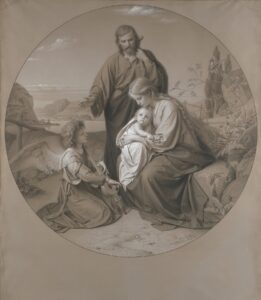
Such teaching is destined to lead us to the perfection of the Christian life, but it is also vital for the peace and stability of our families. Today, the Church turns her eyes towards the Holy Family of Nazareth as an inspiration to all families and communities. Let us then ask the Holy Family for the grace to live this ideal. Let us ask for the grace to understand that oftentimes the peace of the family passes through humble acceptance of facts, of events, of decisions, in the dark, without understanding, with trust that God guides the humble and poor of spirit, even when commands given are wrong or unjust. Let us ask for the grace to live truly in the spirit of the Holy Family, to move forward in faith, with absolute confidence, with submission to those whom God has set over us, knowing that by the path of obedience, we go to God.