
Holy Name of Jesus
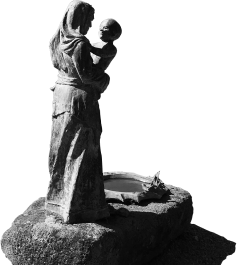
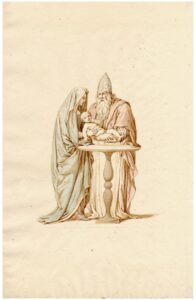
Eight days after His birth, our Saviour was circumcised and received the Name Jesus. Fittingly, we set aside this Sunday to honour that Holy Name from which all grace flows. It is the Name of the Person who, in all of human history, has been loved and venerated like no other. It is the Name that, for those of us who were blessed to be born into a truly Catholic family, we learned to hear and pronounce with devotion from the very lips of our mother. It is the Name that puts to flight all the demons of hell, that gives strength in the midst of all temptations, and fortifies us to live up to the honour that is ours to have been baptised in His Name.
We just heard St Peter tell us in the epistle that there is no salvation in any other. For there is no other name under heaven given to men, whereby we must be saved (Act 4:12). The clarity of that statement need hardly be stressed. It is the foundation of the Church’s missionary spirit. If there is no salvation in any other, that means that, if we love our brothers and sisters in humanity, we must make every feasible effort to bring to them the Name and teaching of Jesus Christ, for without Him they cannot be saved. Indeed, the true Christian is a missionary at heart who is not content to keep for himself the treasure of belonging to Christ but wants to help others attain the joy of knowing Him and living in His grace. This is why Christ came to the world as a babe, so that we could all be led to love Him. Who is not drawn to a babe? Who does not instinctively feel love and affection for an infant? This is why when God entered the world, He chose to do so like any other human, and to go through all the stages of human development. He draws us with the bonds of love.
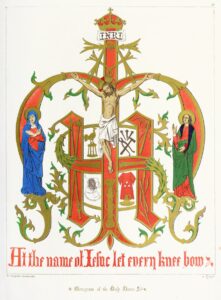
At the same time, the liturgy of this Sunday reminds us that, even though by nature of His being the Son of God, all adoration and honour are already due Him from the very moment of His conception, nevertheless by virtue of having suffered His passion for us, His Name has acquired a further right to our adoration, as He has now been lifted up and glorified at the right hand of the Father. Let’s hear St Paul writing to the Philippians : Have this mind among yourselves, which was in Christ Jesus, who, though He was in the form of God, did not count equality with God a thing to be grasped, but emptied Himself, taking the form of a servant, being born in the likeness of men. And being found in human form He humbled Himself and became obedient unto death, even death on a cross. Therefore God has highly exalted Him and bestowed on Him the Name which is above every name, that at the name of Jesus every knee should bow, in heaven and on earth and under the earth, and every tongue confess that Jesus Christ is Lord, to the glory of God the Father (Ph 2:5-11). In other words, the reason Jesus is exalted and has the Name above all others is that He suffered the death of the cross for us. He humbled Himself and was then exalted.
This experience of Our Lord is not something that happened to Him by accident, nor is it for Him alone. Our Lord Jesus Christ has established in the Church for each of us the same law that governs His own earthly existence. He who exalts himself shall be humbled; he who humbles himself shall be exalted (Mt 23:12). This teaching is, as it were, crystallised in the following words: He that findeth his life, shall lose it: and he that shall lose his life for me, shall find it (Mt 10:39).
What does it mean to ‘find one’s life’? It means seeking out and enjoying every possible way to satisfy our senses and our ego. It means living a life of pleasure and plenty. It means struggling for positions of honour, fame and power, all the while brushing others aside. It means storing up a treasure of good things that flatter the senses and sitting down to enjoy them without a thought for others. Whoever finds his life in this way, says Our Lord, actually loses it. Why? First of all, because none of these things lasts. They all fade away and dissolve, along with our own bodies. But they also lose because instead of using this brief life to find the true life, one has lost one’s time running after shadows that pass and leave one’s soul empty. It is really very bad business to seek to find one’s life in this world and to lose the life that is eternal.
Now, what does it mean to ‘lose one’s life’? It means to renounce oneself, one’s desires, one’s preferences, to willingly set aside things that please us and choose what pleases others. It means to practice penance and self-denial, to mortify oneself, that is to say, to put to death the desires of the flesh. By His own life and example, our Blessed Lord inaugurated such a life for all His disciples. For ALL His disciples. The stern words of the Gospel are directed not only to monks or priests, but to ALL, for he that taketh not up his cross, and followeth Me, is not worthy of Me (Mt 10:38), as Our Blessed Lord makes clear.
Perhaps we are willing to accept this teaching but still find it daunting. Perhaps we do not know how to go about it or where to begin. The answer is so simple. It begins with small things that are at our fingertips each day of our lives. To lose one’s life means to accept the aches and pains of each day without grumbling. It means getting out of bed when the alarm goes off and getting to work on time. It means to embrace the more unpleasant aspects of life. It means working hard at the task that is ours, avoiding laziness, talking back, fighting, cheating, lying, and stealing. It means putting to death the works of the flesh so that the spirit may live.
For the married, it means bearing with the faults and shortcomings of one’s spouse, and never forgetting the vows made before God, ‘for better or for worse’. For parents, it means accepting to be crucified by one’s children, being woken up by them at odd hours, and having one’s patience put to the test by the little hands that get into everything and upset all plans. For a religious, it means embracing the anonymity of the common rule and common ways; it means accepting that the superior and the brothers are there to help us get out of ourselves and progress in sanctity. For a priest, it means allowing the faithful to eat up one’s time and energy. It means allowing others to gird you and take you where you do not want to go, to stretch out your hands and let yourself be nailed to the cross. It means that even moments of leisure are for things that can serve in some way to perfect oneself in the service of souls.
At the end of the day, we can say that the reason the Son of God took our flesh upon Himself and attracted our attention by the comely traits of a tender Child, is to help us realise in ourselves the perfection He Himself inaugurated, to no longer be tossed around by desires and ambitions and false but flattering doctrines, but to remain firm in the truth, in virtue, in the certitude that such is the path to true happiness and to eternal life. And all this is possible through the invocation of the Holy Name of Jesus, that precious oil that has been poured out over us and that softens all that is hard, and anoints and strengthens us to fight and win the battle for our own soul which is the only real battle we need to worry about in the long run, for all others will fade into insignificance, while the battle for our soul has eternal consequences.
Let us never forget, as we go about this new year of grace, that there are a million ways to lose one’s life each day in order to truly find it in God; the opportunities are there at every turn. And let us ever keep in mind that it is by doing these things that the Name of Jesus will be glorified in us and through us for the glory of God the Father. Amen.