
Sunday after the Ascension
We find ourselves in the midst of one of the most intense periods of the liturgical year. Our Blessed Lord has ascended into Heaven, but before leaving us, He has promised the Holy Spirit. This promise was accompanied by the command to wait: He commanded them, that they should not depart from Jerusalem, but should wait for the promise of the Father… You shall be baptized with the Holy Ghost, not many days hence (Acts 1:4-5).
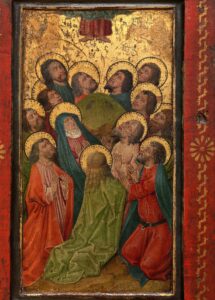
This command of the Lord gives us the first and most fundamental attitude required if we wish to receive an abundant outpouring of the Holy Spirit: we must wait patiently. Let’s note that even though He did say that the coming of the Holy Spirit would be not many days hence, he did not give the apostles a specific day. In a similar manner, when the apostles asked Him when He was going to restore the kingdom of Israel, He replied: It is not for you to know the times or moments – that is to say, the length of periods of history nor the events which bring them to an end and begin other periods –, which the Father hath put in his own power (Acts 1:7). It is enough for us to hear what has been promised, for the promise stirs up our longing, but we must wait patiently for the moment of His visit. By not revealing the precise moment to the apostles, He also made sure that they would be on their guard, ready at every moment. And so began the first retreat in Church history. It is also noteworthy that He told them to wait, not just anywhere, but in Jerusalem, that is to say, the Holy City. For us today, what does it mean to remain in Jerusalem if not that we must remain in the Church? There is no other place where one can obtain the Holy Spirit but within the Church that was founded by Christ Our Lord.
So we know that we must wait in the Church and be ready, but what are the qualities of such a retreat, the outcome of which is to be the outpouring of a Divine Person? Essentially, we can say that the time must be spent in prayer and self-denial. We must give ourselves over to prayer, both vocal and mental, contemplating God’s words and asking for His grace. Our prayer must be humble, and it must be persevering; we must not give up when our prayers are not answered when we want. Let us not forget: It is not for you to know the times or moments which the Father hath put in his own power (Acts 1:7). What we are destined to have forever is worth waiting a long time for.
Our prayerful waiting, however, must also include the practice of the virtues; it is what we might call the quality of our waiting. The passage from the Acts of the Apostles that immediately follows the Lord’s Ascension sets us on the right path. We are told that they returned to Jerusalem … and they went up into an upper room…. And that they were persevering with one mind in prayer with the women, and Mary the mother of Jesus, and with his brethren. (Acts 1:12-14). We must be in communion with the rest of the Church, and we must be in the company of Mary Immaculate.
In these few words, we are given the most important aspects of how to receive the Holy Spirit. We must be with the apostles, that is to say, we must remain within the Church, professing her faith and abiding by the laws that she has laid down for our salvation. Part of being in the Church is being with Mary. Our Blessed Lady is the one who gives unity to the Church. She is in the midst of the apostles and disciples as the perfect image of the Church, as the One in whom the Church already has her perfect achievement – a glorious church, not having spot or wrinkle, or any such thing; but that it should be holy, and without blemish (Eph 5:27). Mary prays with and for the infant Church and gathers all its members under her mantle. But what does it mean to be with Mary, to pray with Mary, to be under her mantle?
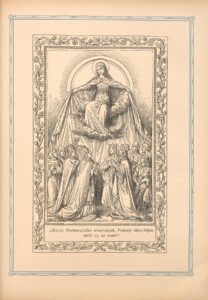
Of course, it means to invoke her intercession, especially through the Holy Rosary. But it also means to persevere in the practice of the virtues which please Mary. And what are those virtues? St Peter puts us on the path when he tells us in today’s epistle: Be prudent therefore, and watch in prayers. Before all things have a constant mutual charity among yourselves: for charity covereth a multitude of sins (1 Pt 4:7-8). If we live in fraternal charity, that is to say, if we truly have love for one another, then we are in preparation mode for receiving the Holy Spirit. If we know how to put others first, to make ourselves the servants of others, and to set aside our own pleasures in order to do what pleases others. It is to see Christ in the one who is little, who is poor, who is sick, who is needy. When God sees a community in which fraternal charity reigns, He is moved to send an abundant gift of the Spirit. Whereas a self-centred community in which the members only think of themselves closes off divine grace, for it cannot penetrate hearts that are turned in on themselves. God is eternal self-giving in His Trinity of Persons, and He can only give Himself to those who imitate that attitude of love for and openness to others.
There is another virtue that is dear to Our Blessed Lady, and that is required if we wish to receive the Holy Spirit in abundance. And that is the virtue of personal discipline called chastity. It is no accident that the Holy Spirit is poured out upon the apostles gathered around the Immaculate Virgin. God loves pure souls. He loves those who have always been pure. He loves those who have been purified through the humble confession of their impurities.
This point must be insisted on today when we see a concerted effort to distort the teaching of the Gospel and change the teaching of the Church on the use of human sexuality. There is much talk in the Church at the moment of being on a journey together, of making space so that all can walk along, of excluding no one. For many, it would seem, this journey signifies that we should not be so demanding of the way people live. We should allow couples to contracept, to divorce and remarry; we should allow same-sex partnerships. As for personal chastity, that’s not even on the radar. But all this is diametrically opposed to God, and it makes it impossible for the Gift of the Holy Spirit.
In the first lines of the Book of Wisdom, we are told: Wisdom will not enter into a malicious soul, nor dwell in a body subject to sins (Wis 1:4). Wisdom will not dwell in a body that is subdued by sin. Wisdom dwells in a body that fights to be chaste, that wages war against the passions and the continual enticements that seek to draw the soul away from God. But Wisdom cannot dwell in a body that gives in, that refuses to use its spiritual weapons, and stops fighting. The same must be said of the Body of the Church. We are told that the Church is on a journey today and that all are called to walk the journey together. Where is the journey heading? We are not told. But the real questions that we need to be asking ourselves are these: of all those engaged in this journey, how many of them have esteem for the virtue of chastity and fight to maintain it? Among the clergy and religious, how many live their sacred commitments to perfect chastity? Among the married, how many live in fidelity to their spouse, even in thought – pornography is an easy and constantly available form of the grave sin of adultery – and keep the Church’s teaching on openness to life, refusing to dry up the sources of life through contraception? Among the unmarried, how many mortify their flesh to remain pure and refuse to satisfy their passions? When we see even cardinals pushing for a change in the Church’s teaching, we can only wonder just how many of those on this journey are actually the Temples of the Holy Spirit. Wisdom will not dwell in a body subject to sins (Wis 1:4). Wisdom does not dwell in a body that is subdued by the sins of the flesh. It doesn’t matter how many people are living in sin; Wisdom will not dwell in them, and their decisions will not be guided by God.
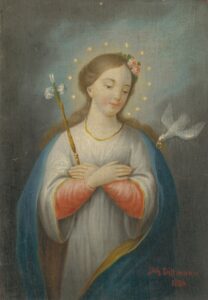
As we prepare for the great feast of Pentecost, let us take the cue from what we are told today. Let us strive to have true, self-sacrificing charity for all. Let us learn to put others first, to give up what pleases us. Let us strive to grow in all the virtues, especially those that are most pleasing to the Immaculate Mother of God. If we do this, we can trust that we will truly be enlightened by the Holy Spirit, and He will show us the path to a blessed eternity, which is the only journey that matters.
If we do not do this, if we imagine that we can be Catholics and live as we please, if we delude ourselves into thinking that we can change God’s law and call it a journey, then our celebration of Pentecost will not only be futile and barren. It will be the worship of false gods, idols of corruptible flesh that we have made for ourselves, and that only lead to eternal death. The apostle’s words are unequivocal: Know you not, that you are the temple of God, and that the Spirit of God dwelleth in you? But if any man violate the temple of God, him shall God destroy. For God’s temple is holy, and that temple you are (1 Cor 3:16-17).