
Finding of the Holy Cross
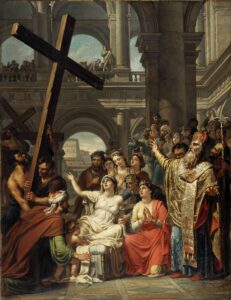
Today’s feast takes us back exactly one month, to Good Friday. It also takes us back to the early 4th century when St Helena discovered the True Cross in Jerusalem. The day has come to have a double focal point. The first is to render due honour to the wood of the Cross itself. The Cross is due our veneration because of the excellence of the Divine Person who sanctified it with His Blood, pouring it out for our salvation. The second objective of the feast is to help us contemplate this great mystery: God saved us through His sufferings. He ‘invented’ (this is a play on the Latin word inventio, which means finding and is the Latin title of today’s feast – Inventio Sanctae Crucis.) The amazing thing is that the Cross really is an ‘invention’ in the modern English sense of the word, an invention which only God could have come up with: turning an instrument of humiliation, torture and death into the means by which eternal life and glory are given to us. It is the great paradox that is the very heart of the Church’s celebration of the Holy Cross.
Neither of these points will meet with objections from those who know their faith. Any true Christian will readily admit that Christ saved us through the Cross, making the Cross the symbol par excellence of the Christian faith. What is much harder to accept is that we must all, not just admire and venerate the mystery of the Cross, but live it. We must take up our Cross and carry it to death. We, too, must have our bitter passion. We, too, must be painfully nailed to our lifelong duties and commitments. This is in some respects an even greater mystery. As proof of this statement, we need only note that we have so much difficulty accepting it, and many simply refuse it. Yet, our life is marked with the Cross from the day of our Baptism till that of our final anointing, passing through the uncounted signs of the Cross made over us by the priest in administering the sacraments, and those that we make over ourselves in memory of the passion of Our Blessed Lord whenever we pray.
The passage from the Gospel that we read today may help us understand. It recounts the episode of Nicodemus who goes by night to see Our Lord, and it concludes with these words: As Moses lifted up the serpent in the desert, so must the Son of man be lifted up: that whosoever believeth in him, may not perish; but may have life everlasting (Jn 3:14-15). Our Lord refers to the bronze serpent that Moses made to heal those who had been bitten by serpents after murmuring against the Lord, showing the prophetic nature of this event: just as the Hebrews, in order to be healed of their bite, had to humble themselves and look up at the serpent – that is to say the one that had grievously wounded them – so we must look up at the Lord stretched out on the Cross – that is to say, the one who calls us to follow Him in suffering, in order to receive the saving and healing effects of His grace.
But there is another aspect to Our Blessed Lord’s words to Nicodemus that might help us come to terms with this teaching on the Cross, and this concerns the new life of grace, which is a gift of the Holy Spirit. Our Lord tells Nicodemus that we must be reborn of the Spirit if we are to be able to follow Jesus: The Spirit breatheth where he will; and thou hearest his voice, but thou knowest not whence he cometh, and whither he goeth: so is every one that is born of the Spirit (Jn 3:8). We know not whence He cometh, for His coming astounds us. He asks us to embrace the Cross, which we find repugnant, and so we have to be born again to understand. We speak what we know, and we testify what we have seen, and you receive not our testimony. If I have spoken to you earthly things, and you believe not; how will you believe, if I shall speak to you heavenly things? (Jn 3:11-12). Only grace can convince us of this, for only grace teaches us to trust the word of Jesus.
St Paul is one who understood it. In his second epistle to the Corinthians, he writes the following words that we read yesterday on the feast of St Athanasius: In all things we suffer tribulation, but are not distressed; we are straitened, but are not destitute; we suffer persecution, but are not forsaken; we are cast down, but we perish not: always bearing about in our body the death of Jesus, that the life also of Jesus may be made manifest in our bodies. For we who live are always delivered unto death for Jesus’ sake; that the life also of Jesus may be made manifest in our mortal flesh (2 Cor 5:8-11). In all things, the Cross of Christ is ever present in our lives, and if we willingly take such an austere path, we will be led to the new, risen life of Jesus.
Probably none of us will be nailed to a Cross. Probably none of us will be publicly flogged. Most of us will not go to prison or be publicly derided for defending the truth of our faith. But all of us are daily faced with crosses that are heavy, burdensome, and from which our fickle egos so desperately want to run away. It’s easy to run away. It’s so banal these days that people give up so easily. People give up on everything today; they give up on learning skills and on handing them down, because there is too much effort involved; they give up on careers when there is too much work and not enough leisure; they give up on having a good influence in society when the opposition is too great; they give up on making themselves useful to society, and many take what appears to be the easy way out; they give up on solemn commitments such as marriage vows or religious vows; they even give up on their own children, or vice-versa on their own parents. Today, people give up on everything; they rarely arouse themselves to go the distance, to endure, to stick things out. Most people today don’t even know the meaning of the words: For better, for worse, for richer, for poorer, in sickness and in health, till death do us part. For most people, those words sound like a foreign language, from another planet in another galaxy in some other age.
And yet, to persevere, to endure, to stand our ground and do something constructive, such as being faithful to the one to whom you have vowed your life, is the first and the most important way of carrying our Cross, of letting the life of Jesus become manifest in our daily deaths: it means understanding there is nothing at all exciting about running away. It means to be conscious that running away from the challenge is boring, it’s banal, it leaves you empty, it deprives you not only of grace, but also of your humanity, and you are the one who finds yourself an alien from another planet. It means accepting that standing up and carrying the Cross is really the only exciting part of our lives, for it is truly the litmus test that shows what we are made of.
Putting your leisure, your pleasure and even your life on the line to keep your word and be faithful to your God is really the only kind of excitement that it’s worth living for. One who has not done this has not really lived a human life. Noblesse oblige. We are not aliens, and we are not animals.
Grace is not cheap. It was not meant to be. We are made for higher things, so let’s stop looking for excuses and start looking up at the Cross, and so let ourselves be swept away by the Spirit, to that new life, that new outlook on things which turns its back on the petty interests of a secularised world and turns resolutely with Jesus to march towards Calvary, and beyond, to the Empty Tomb.