
Third Sunday after Easter
A woman, when she is in labour, hath sorrow, because her hour is come; but when she hath brought forth the child, she remembereth no more the anguish, for joy that a man is born into the world. So also you now indeed have sorrow; but I will see you again, and your heart shall rejoice; and your joy no man shall take from you (Jn 16:21-22).
These words of our Blessed Lord, with which today’s Gospel passage concludes, bring before our eyes a natural reality, namely, the pain and anguish involved in childbirth, and the joy that ensues. It is a reality of nature we are aware of, even if only some of us have firsthand experience of it. Here, the Lord uses it to express the pain of being separated from Him and the subsequent joy of being reunited. Let’s be quick to point out that we are here talking about someone who has already come to love Our Saviour and who then must go through a time of trial during which He seems to be absent. It is a well-known procedure and is commonly commented on by spiritual authors. No one can go straight to God and always be in the light. One must go through times of sorrow and difficulty that test the soul’s love and allow it to grow.
Last week, we spent some time considering the Good Shepherd in action when He helped the apostles during their dark night on the lake. Today, I suggest we return once again to Easter week and consider another aspect of that same love by which Our Blessed Lord does not forget those who have loved Him but who now find themselves in sorrow.
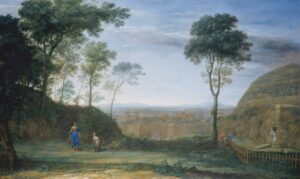
St John is once again the one who relates this scene involving Mary Magdalene. Mary had been among the group of women who rose before dawn to make their way to the sepulchre in order to finish rendering to the body of Jesus the final honours they had to abridge on Good Friday afternoon. It would seem that Mary, upon seeing the open tomb, immediately jumped to the conclusion that someone had stolen His sacred body. Without a second’s delay, and without seeing the angels whom the other women saw, she runs back to tell the apostles. Peter and John run to the grave, followed by Magdalene. John arrives first, followed by Peter. They both inspect the inside of the tomb. They see the burial shroud in the same position in which it had covered the body of Our Lord, but now empty of its prize. They then both go off, pondering the meaning of this unexpected event. But let’s return to Magdalene.
John tells us that when the apostles went away, she did not. She stayed. She could not bear to distance herself from the place where she had last seen the body of her beloved Lord. Her thought processes are troubled. She does not stop to think things through. If she had, she would have inspected the tomb herself, and the mere sight of the burial cloths would have convinced her that His body had not been stolen. But her love is too great and her sorrow too deep to reason. All she knows is that her Jesus was placed there on Good Friday afternoon. She herself had been there with His Mother and John and the other women. She knew He was there. And if He was there, then, she thinks, I’m not going anywhere until I find Him.
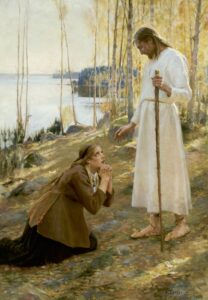
Thereupon, the Lord sends angels to ask her: Woman, why weepest thou? Amazing the power of love – so great that not even the sight of angels affects the soul taken by it. She converses with them as if it were the most natural thing in the world, for what are angels when you are looking for the eternal Bridegroom Himself? She saith to them: Because they have taken away my Lord; and I know not where they have laid him (Jn 21:13). Our Lord, the Good Shepherd, the King of angels, is touched by her faithful love, and He Himself comes from behind and asks her: Woman, why weepest thou? whom seekest thou? This time, she thinks it must be the gardener, and so she replies: Sir, if thou hast taken him hence, tell me where thou hast laid him, and I will take him away (Jn 21:15). Once again, we see the same drive: to find the body of Jesus, but this time coupled with the conviction that love knows no limits: just as she (and the other women) did not give a thought to how the great stone enclosing the tomb would be opened, so here Magdalene thinks nothing of carrying off the corpse of a grown man: love gives wings!
At this moving protestation of her love, Our Lord Himself is moved and will no longer keep her waiting. A simple word will suffice, her name: Jesus saith to her: Mary. She turning, saith to him: Rabboni (which is to say, Master) (Jn 21:16). Thereupon Magdalene reaches out to take hold of the blessed feet of the Saviour, those same feet she had wept over on the day of her conversion, but now not quite the same, for they bear the marks of the Passion, deep holes through which passed the spikes that had attached Him to the cross. Jesus concludes this brief scene with a mysterious refusal: Jesus saith to her: Do not touch me, for I am not yet ascended to my Father (Jn 21:16).
Our Lord’s meaning is that He wants to help Magdalene to achieve a higher level of love. Up to now, her love for Him was no doubt too earthly. She had come a long way since the days of her sinful life, but there was still a much longer way to go. We know from tradition that she spent the next few decades in a cave in southern France, where she wept for her sins and pondered the mysterious events of the life of the One to whom she had been called to bear witness. She, the repentant courtesan, receives the unique grace of being the apostle of the apostles, for she is the one who will announce the Resurrection to them. But go to my brethren, and say to them: I ascend to my Father and to your Father, to my God and your God (Jn 21:16).
Mary Magdalene had no children, and yet on her feast day, the liturgy calls her Pia Mater et Humilis – Humble and Devout Mother. Even though she did not know the pains and joys of childbirth, she is our mother, for she came to know the mysterious sorrows and joys referred to in today’s Gospel when she experienced the unbearable sorrow of losing God during the dark night of His passion and then the immeasurable and unending joy of finding Him again on the morning of the Resurrection. In this, Mary Magdalene is the model of the Christian soul who truly seeks God, who truly wants God, whose only ambition is to be with God. And God, in turn, teaches such a soul the ways of the spirit, which are mirrored in the ways of nature. Just as childbirth symbolises the passage from sorrow to joy in God, so the subsequent events in the life of a child symbolise the way God deals with souls who truly seek Him. He spoils them at first like an infant, but then He weans them to make them grow. Listen to one of the greatest spiritual masters, St John of the Cross:
‘When a person turns to the service of God with real determination, God normally nurtures his spirit and warms his heart, as a loving mother does to her little child – she warms the child at the breast and feeds him with sweet milk and mild and sweet food, and carries him in her arms and hugs him. But as he grows, the mother… puts him down and makes him walk on foot. She does this so that he can leave behind childish ways and take on greater things. It is the same with the soul: the loving mother of the grace of God brings him to rebirth through a new warmth and enthusiasm for serving God:… God offers him sweet and satisfying spiritual milk, without effort on the soul’s part, and great attraction for spirituality…. But when God senses that he has grown up a bit, God draws him away from the sweet breast and puts him down and gets him used to walking on foot so that he can grow strong and leave his baby-clothes behind; and he finds this new phase bewildering, since everything has turned back-to-front. Here God gives the person to taste the food of the strong, which in this dryness and darkness the spirit begins to receive in its dry emptiness’ (Dark Night of the Soul, Book 1).
Remember how we said last week that we must make an effort to stay empty, to not fill ourselves with creatures, if we want to be filled with God. Today we learn that this filling does not happen without being weaned even from spiritual consolations. If you have ever experienced the inexpressible joy of God, the unworldly attraction of the altar and the tabernacle where the Risen Jesus remains with us till the end of time, do not forget it, in your moments of sorrow, desolation or especially if you are drawn to give up and despair. Remain there, like our dear mother Magdalene at the tomb. Remain in front of the tabernacle. Do not go looking for consolation from creatures – not in food, not in drink, not in the pleasures of the flesh, not in mindless browsing or senseless chatter. You know they cannot console you, but will only leave you worse than before. Remain there and weep, and wait, and know that the Beloved of our souls has not forgotten you. No, He is just testing your love, for He wants it to grow, and as it grows, to increase the vehemence of the search. If you seek and seem not to find, persevere in seeking, and you will find Him, for ‘longing increases when unsatisfied, and thus increased, can retain what it finds’ (St Gregory the Great).