
Good Friday
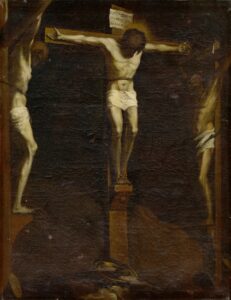
As the Passion of Our Blessed Lord progresses and the almost too-hard-to-listen-to physical sufferings are heaped upon Him in ever seemingly unbearable doses, at the same time, we see a growing isolation and abandonment of the Saviour. When Holy Week opens on Palm Sunday, we see Him surrounded with enthusiasm by huge crowds that sing His Name. When the Passion story opens with the prophetic anointing in Bethany and while He preaches in the Temple in the days leading up to Good Friday, we contemplate Him surrounded by crowds showing Him their love, veneration and gratitude. At the Last Supper and in the Garden of Olives, He is supported by the Twelve who pledge they will follow Him to death. But then Jesus is taken prisoner, they all run away, the priestly anointing still fresh upon them. The legions of sick whom He had healed are nowhere to be seen. Jesus is alone, abandoned, isolated. And even when the Father does afford Him the loyalty of a handful – Our Lady, of course, Magdalen and the other women, and St John who finds his way to Calvary thanks to Our Lady, Simon the Cyrenian, Veronica – nevertheless, among His faithful followers there is not a single one who can actually do something to help Him. None of the key players in the events of the first Good Friday, even if they are conscious of His innocence, will do anything to help Him. He is derelict. An attentive reader of the prophecies of the Old Testament and the accounts of the Passion in the New Testament cannot fail to notice this point, which in many ways seems almost accidental compared to the flogging, the crowning with thorns and the crucifixion, and yet for one who loves, for one who has come to experience that the only real consolation in life is the support of real friends, it must have been the most painful part of the Passion: the turning away of disciples, the cowardice of apostles – there is no one to help. Utterly alone.
Several weeks ago, while preaching the annual Lenten retreat to the Holy Father and members of the Roman Curia, Bishop Erik Varden had these profound words: ‘To subscribe to a Christian idea of freedom is to consent to pain’. The Bishop here touches on a not very well-known or appreciated aspect of suffering. It is really only the acceptance of suffering that makes us free. Suffering is often the only means by which a soul can, as it were, be opened up. We might compare most souls to, say, a walnut. It takes a considerable amount of force to crack open a walnut, but until we employ that force, we can never get to its tender and nourishing contents.
Souls need to be ‘cracked open’ – suffering plays that role of forcing an entrance. There is no doubt that many saints in Heaven right now owe their eternal crown to the serious pain that forced them to halt their fatal march towards eternal death. But suffering not only opens us up to God’s grace; it also opens us up to others. Only one who has suffered is able to feel true compassion for those who suffer now. And so we see what Bishop Varden meant when he said: To subscribe to a Christian idea of freedom is to consent to pain. And now we also understand better why Christ Our Lord accepted to undergo the cross, why He accepted to walk the path alone, abandoned by all.
The Church, too, lives out her passion in every age. The masses, both of clergy and laity, are happy to proclaim their faith when there are no risks to their comfort. But when the powers that be exert pressure, the true friends of Christ dwindle. People do not like truth-tellers, because it is so much more comfortable to cruise along without any waves to upset the tranquillity of their lives. In times of crisis, there are usually only a handful of courageous souls who are fearless enough to call out sins and errors. Around them, there may be small pockets of admirers, but they, too, must undergo being abandoned and shoved aside as irrelevant.
Last Sunday, I suggested we pray for the grace of an increased capacity for suffering. Today, I add the grace to know how to suffer alone, to accept being among those who are not considered to be in the know or behind the scenes. The grace to be able to receive the condescending smile that says: ‘Oh, you poor thing, you simply are not sophisticated enough’. The grace to be shut down from speaking out because no one else is doing so.
It is indeed a grace, for suffering of itself does not make one holy. We all know people who have been embittered by pain and solitude. Suffering of itself does not help, nor does it sanctify. It’s all about what you do with it. The example of Our Lord is there to show us how to deal with pain, and in particular with the pain of bearing the burden alone and being abandoned by loved ones.
All this should inspire us and give us courage. But there is another thought that should prevent us from being brought low by whatever pains we may have in our lives, and it is a thought that gave incentive to many saints. If God has decreed that sin be atoned for by suffering and that suffering produce saints, He has also decreed that the time for such suffering be the brief, virtually momentary time of this passing life. We have only this short life to suffer for Our Lord, to prove to Him how much we love Him, to become more and more like Him. We have only the passing moment that is right here in front of us. When the cross is heavy, let us remind ourselves of this. The time of the passion is brief, but the way we accept it – or fail to do so – will determine our closeness to God or distance from Him in eternity. For those who understand this, when the time of their own death comes, they are saddened, not because they have to leave this world – they know they are going to God! – but because they leave it without having done enough for God, without having done everything possible for Him and satisfied the demands of His love.
The great Bossuet wrote: ‘There is nothing in the world greater than Jesus Christ; there is nothing in Jesus Christ greater than His sacrifice; there is nothing in His sacrifice greater than His last sigh, and the precious moment that separated His most holy soul from His adorable body’. By these words, the great orator wanted to stress that the last moment at which Our Blessed Lord breathed forth His soul to the Father was the culmination of a life lived entirely for His glory. It was the acceptance of all that He had to suffer from those who should have stood with Him.
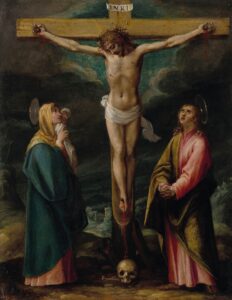
Let us ask Mother Mary, the Mother of Sorrows, as she stands at the foot of the cross and undergoes the sneers of the crowd, to obtain for us this grace of not being afraid to stand alone for what is right, for what is true. Like we said last night, it sometimes takes time for a soul to be transformed, to understand these things. There is no better time to begin than right here and right now.