Nativity of Our Lord
As we celebrate the joyful event of Our Lord’s Nativity, which is without a shadow of a doubt the most significant event in human history, we are confronted with a contrast that at once tells us a very profound lesson about God and gives us a very important key for understanding our role in His plan.
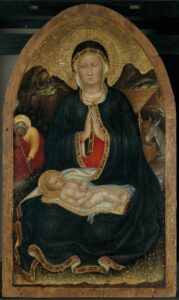
When God enters our history, He does not do as we would expect, and as the great celebrities of our world do. We sound a trumpet, we roll out the red carpet, and we offer them every possible sign of honour and respect. People trip over themselves making sure that every detail is perfect so that their eyes will not be offended. When God makes His entry, He chooses the most out-of-the-way place in the world, and not only that, He furthermore arranges events so that even in that place He is only a passerby, unknown, unexpected and unwanted. The birth of God in history seems at first sight to be so insignificant that if we had chanced to be walking by the stable on the outskirts of Bethlehem on the first Christmas morning and had seen the sight of a newborn babe with his parents, all shivering with cold, we probably would have been less moved to pity than to scorn. Any number of uncharitable thoughts would have probably occurred to our minds as to how such a young girl could have had a baby, and in such dire circumstances. Most probably, we would have made haste to move on and forget, abandoning them to their sad fate.
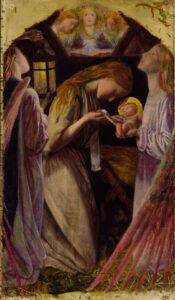
So what does this teach us about God? Many things, but for tonight I will insist on only one: God is so far from making light of our misery that He wants to share it, He wants to be part of it, He wants to choose the last place so that no one can ever take it from Him, so that no one can ever complain that God does not know what it means to be small, to be rejected, to suffer, to ask for help and receive none. That is the first lesson: God is close to us, much closer than we can possibly imagine, and so we are never justified in complaining that He is far. He is actually so near that He is more involved even than we are.
But it also teaches us much about ourselves and about how to become the saints God meant us to become when He became a Babe. God is at our sides day and night, even amid the most insignificant and unpleasant situations. More often than not, He appears to us as someone in need: an unborn child in danger of being silently suppressed; a child destitute of parents; a pregnant, abandoned girl; a person confined to bed with no one to visit and no one to help pay the bills; an elderly person long forgotten in a nursing home. He most often appears to us in the events of our daily lives that don’t seem worth mentioning: the meal we slaved over and for which no one said ‘thank you’; the rubbish bin we have emptied a thousand times and still no one else thinks it worthwhile; the floor that was swept an hour ago and now is once again full of mud because people just don’t think when they come into the house; the misinterpretation of a remark that was meant to be kind but was taken as an insult; the heroic move to protect someone in need which is seen as an act of grooming or ambition; the umpteenth attempt at doing something we are so good at, but our health prevents us and we appear to the world as a lazy profiteer… and the list could go on, each of us adding to it from day to day.
The point is: those are the events in which Jesus Christ is born, or rather, wants to be born in our lives, and through us in the lives of others. The problem is, like the inhabitants of Bethlehem, we have so many other more important things to be doing, our little pastimes and passions, our petty comforts that prevent us from seeing that this very morning, the Christ Child was knocking at my door and I failed to hear, or when I opened I just knew that He wasn’t worth my time. I have so many more important things to do that I have no time to go out to a stinking stable and help people who could have helped themselves.
All these moments, at the end of our lives, will pile up in front of us. We will be ashamed that, like everyone else, we failed to open our house to the newborn King. He had to wait, a very long time, for a very few souls to get to know Him, to appreciate Him as He truly deserves, to give Him, not a few minutes of their time or a few dollars of their earnings, but their lives, their entire lives, with every ounce of their energy. And how did they do that? Because they were small enough, humble enough, pure enough, detached enough, to stop what they were doing, to spend time with the stranger, the ignorant, the weak and the sick, and there, they came to know Jesus, and they were taken with His love, and they could not turn back. For when you have truly come to know Jesus Christ, life is never the same again. You begin to see Him everywhere, and every event, especially the hardest ones, the ones that resemble most the ordeal of Bethlehem, are so many opportunities to prove one’s undivided love.
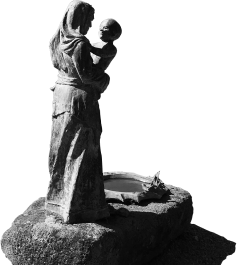
Then can begin to take shape and take life the ineffable reality that St Francis of Assisi expressed when he wrote: “We are mothers of our Lord Jesus Christ when we carry him in our hearts and in our bodies, lovingly, and with a pure and sincere conscience, and give birth to him through the working of his grace in us which should shine forth as an example to others.”
Such is the grace of Christmas. Yes, we too can emulate Mother Mary. She alone gave birth to Him in the flesh, but we can all give birth to Him in the spirit by carrying Him in our hearts, consoling Him with our love, and bringing Him forth to others by a life that is truly Christian, that is to say, a life that is truly like Christ, Christ poor, Christ humble, Christ the servant, Christ who always has time for others, for all others, even to the shedding of the last drop of His blood. Such is the grace, the grace of truly becoming a disciple of Christ, that we monks pray that you will come to know and to receive and live, ever more and more, this Christmas and always. Amen.