
Gaudete Sunday
With the feast of Our Lord’s Nativity just ten days away, our Mother the Holy Catholic Church invites us, or rather commands us, to rejoice. It’s an opportunity to reflect a bit upon what joy is and what it isn’t. Although we are all familiar with the word and with experiences we would qualify as joyful, if we take a closer look at those, I suspect we would find, for the most part, moments when we were excited because things turned out well for us or for someone we love. But would they qualify for what St Paul calls joy in today’s epistle to the Philippians?
To help us answer that question, let’s read a passage from another of the Pauline epistles, the first to the Corinthians, in which he writes the following: From now on, let those who have wives live as though they had none, and those who mourn as though they were not mourning, and those who rejoice as though they were not rejoicing, and those who buy as though they had no goods, and those who deal with the world as though they had no dealings with it. For the present form of this world is passing away (1 Cor 7:29-31).
Let those who rejoice be as though they were not rejoicing – with these words, St Paul is clearly referring to a joy that is not that of the Holy Spirit, but rather that of the earthly creature, the person who is happy because they have found a nice home, landed a good job, received a promotion, or quite simply, has just had a nice meal with friends. This sort of natural mirth is not true joy, and it does not last. Worse, it can distract us from true joys. This is why St Paul tells us not to lay too much store by it. When we have such moments – and those moments can be good in themselves –whenever we or those around us are happy with a worldly mirth, those who have come to know Christ must rejoice without rejoicing. That is to say, we must always remain a step or two removed from that mirth, so as not to let it take control of us and affect our focus on God and on eternity. Why? Quite simply, because God and eternity with Him is the only motive that is worthy of our undivided attention, the only reality that can give us real and lasting joy. We were not made for a creature, so no creature can give us joy. This is no doubt why finding a truly joyful person is a rare occasion indeed. Most people, sadly, do not know what real joy is because they live on the surface of things, on the outside, intent on appearances rather than on what truly matters.
Now, with all this in mind, we can read again what St Paul tells us today: Rejoice in the Lord always; again I will say, rejoice. Let your modesty be known to everyone. The Lord is at hand; do not be anxious about anything, but in everything by prayer and supplication with thanksgiving let your requests be made known to God. And the peace of God, which surpasses all understanding, will guard your hearts and your minds in Christ Jesus (Ph 4:4-7).
That is true joy, founded in the Lord, in the imminence of His coming, and when it is possessed, it can never be taken away from one who is in a state of grace. If God Himself dwells in our hearts, and if we believe in His promises, then there is no earthly situation that can possibly deprive us of that joy. We might fall gravely ill, we might lose a cherished house or position or a great amount of silver or gold, we might even lose the dearest person in our lives, such as a spouse, a parent, a child, or a beloved and trusted friend. What does all that matter when you have God and when you know – you are certain! – that He is coming and that He is very near, indeed, at the very door? Such is what the apostle is trying to get across to us today. That joy, founded on Christ, produces a peace that the world does not know, that the world cannot know, for it does not know Him who is its source.
St Benedict, for his part, attempts to show how such joy should persist, not only in the midst of painful events which might be nobody’s fault – such as bad health or weather –, but even amidst the greatest hardships we might have to endure from others. When he comes to speak of the virtue of humility and describes that state where the true monk – let’s say any really fervent Christian soul – accepts being slighted and humiliated out of love for Christ, then he notes that in the midst of that humanly unpleasant situation, joy, true joy, should always remain and preside over the other affections of our hearts. Hear the Patriarch of Monks:
‘The fourth degree of humility is that meeting in this obedience with difficulties and contradictions and even injustice, he should with a silent mind hold fast to patience, and enduring neither tire nor run away, for the Scripture saith: He that shall persevere to the end shall be saved. (Mt 10:22). And again: Let thy heart take courage, and wait thou for the Lord (Ps 26:14). And showing how the true disciple ought to endure all things, however contrary, for the Lord, it saith in the person of sufferers: For thy sake we are put to death all the day long. We are accounted as sheep for the slaughter (Ps 43:11). Then, confident in their hope of the divine reward, they go on with joy to declare: But in all these things we overcome, through him that hath loved us. (Rm 8:37). And again in another place the Scripture saith: Thou, O God, hast proved us: thou hast tried us by fire, as silver is tried. Thou hast brought us into the snare: thou hast laid afflictions on our back. (Ps 65:10-11) And to show that we ought to be under a superior, it goeth on to say: Thou hast set men over our heads (Ps 65:12). Moreover, in adversities and injuries they patiently fulfil the Lord’s commands: when struck on one cheek they offer the other, when robbed of their tunic they surrender also their cloak, when forced to go a mile they go two, with the apostle Paul they bear with false brethren, and they bless those that curse them’ (Rule of St Benedict, ch. 7).
So it is clear that true joy can coincide with great suffering. But really, we should go a step further and add that true joy cannot exist without suffering, not in this life. As the Imitation of Christ says: ‘When thou hast come to this, that tribulation is sweet and pleasant to thee for Christ’s sake, then reckon that it is well with thee, because thou hast found paradise on earth’ (Book 2, ch. 12).
This joy is truly the treasure hidden in a field, it is the pearl of great price that a man will give everything for (Cf. Mt 13:44-45). It is a treasure hidden in the heart, a pearl buried deep in the soul, that abides, despite the waves of strife that may and will swell over our emotions and passions, despite whatever suffering, just or unjust, we may meet with. The one who has truly met Jesus and truly knows Him, lives in the certitude that he/she is loved, is held, is cherished by God Himself, the certitude that no one can snatch us from His hand (cf. Jn 10:28-29). Such is the source of joy that as disciples of Christ, we should have in us. If we do not yet have it, all it means is that there is still work to do in becoming true disciples of Our Blessed Lord. There is something we have not yet given up, something that still holds us back from belonging totally to God, a screen we have put up between Him and ourselves, a screen He wants to break down by His new coming at Christmas.
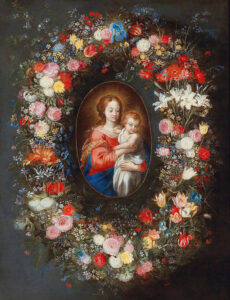
In the Litany of Loretto, we invoke our Lady as causa nostrae laetitiae – cause of our joy. She truly is so because she is the cause of the very source of our joy, namely her beloved Son, who is about to come to us again in a special way at Christmas. In this last run up to the great feast, let us fervently pray and make sacrifices, offering ourselves generously to Our Lord, and maybe this year, on the holy night, the silent night, we will at last get a taste of that true joy, which in this life will always be mingled with tears, but is nevertheless there and sets us apart from those who have no hope.