
Second Sunday of Advent
During the penitential periods of the year, we sing every Saturday the second canticle of Moses, otherwise known as the Canticle of Deuteronomy (ch. 32). The canticle is a long meditation on the marvellous deeds of God towards His chosen people, but mixed with reminders of all its failings, and what happens to it when it turns away from God. One can easily apply it to oneself, passing in review all the wonderful things God has done for each of us, and humbly acknowledging that all too often we have acted as the Hebrews did, like spoiled children, unconscious of so many divine benefits and ungrateful for having been saved from so many ills.
Many of the canticle’s utterances seem to apply uncannily to us today. They provoked him by strange gods, and stirred him up to anger, with their abominations. They sacrificed to devils and not to God: to gods whom they knew not: that were newly come up, whom their fathers worshipped not. Thou hast forsaken the God that begot thee, and hast forgotten the Lord that created thee. (Dt 32:16-18).
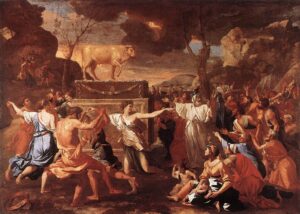
Clearly, God is upset and hurt when His own children turn their backs on Him and run off to idols. What are our idols today? What false gods do we worship? Too many to count. But at the top of the list, as the source of the others, is no doubt the religious indifferentism which is all-pervasive in our society. Having no religion is as good as having one; one religion is as good as another; each person only answers to himself, and the body politic must respect equally all religions, including Satanism. This indifferentism leads to all sorts of vices: life no longer has any value, virtue is not honoured, vice is promoted, lies are considered true, and injustice is considered right.
The canticle goes on: The Lord saw, and was moved to wrath: because his own sons and daughters provoked him. And he said: I will hide my face from them, and will consider what their last end shall be: for it is a perverse generation, and unfaithful children. They have provoked me with that which was no god, and have angered me with their vanities: and I will provoke them with that which is no people, and will vex them with a foolish nation (Dt 32:19-21).
Amazing: ungrateful children provoke God by going and prostituting themselves to false gods, and what does God do? You provoked me with “no god”; well, I will provoke you with that which is a “no people”. Since you go off to worship one that is no god at all but has only the appearance of a god, you will be punished by a people that is no people but which has only the appearance of being a people. This brings to mind the observation of St Augustine, that a people that does not obey the natural law is no people at all, but simply a gathering of brigands. Where shall we find a true people today? We de facto find ourselves under the rule of brigands, people who hold power but for whom God’s law does not exist, and who consequently arrogate to themselves the power to change the sacred laws received from tradition, and thus lead our world, step by step, into the dark, dismal abyss of anarchy.
The canticle goes on: They are a nation void of counsel, and without wisdom. O that they would be wise and would understand, and would provide for their last end (Dt 32:28-29). A nation void of counsel: We have before our very eyes so many examples of the most extreme folly, so extreme that it defies belief. Men and women endowed with the authority of a nation who are not ashamed to make decisions against the wisdom, not of a few decades or centuries, but of millennia, of the entirety of human history, as if all of a sudden we, in the 21st century are wise enough and smart enough and clever enough and courageous enough to kill just the right people at the right time. We alone of all generations since the beginning of time can trust ourselves to decide who can live and who is to die. The arrogance, the sheer stupidity of it, really does defy belief. And yet it is happening before our very eyes. Thou art a nation devoid of counsel, a nation of fools. The mere sight of it is pathetic. If this does not move us, then I’m afraid something is seriously wrong. That is the bad news of today’s world. Now for the good news.
Amidst so many evils, God does not abandon His people. He takes no delight in punishing, but He knows that it is sometimes what we need. He punishes His people by handing them over for a time to their enemies, but in the end He will chastise those enemies themselves. The canticle continues: The Lord will judge his people, and will have mercy on his servants (Dt 32:36). Yes, one day, please God, we will wake up from our torpor. We will rise and turn back to our God, for we will realise that we had run off after a “no god” and were punished by a “no people”. And on that day, He will turn back to us.
People of Sion, behold the Lord will come and save thee, we sang at the Introit. The people of Sion, that is to say, the people who have not turned their back on God, who have turned away from false gods, who have not discarded or distorted the commandments. He will come and save those who listen to His prophet clothed in a camel’s skin and eating locusts, that is to say, the one who lives a humble, mortified life, who is prepared to stand up to the modern Herods who, in reality, are like the reed shaken by every wind of passion.
The people of Sion are those who stand firm with Christ amidst persecution, and merit to hear that word of the Lord: Blessed are you when men persecute and revile you, when they throw your name out as if it were something evil. Rejoice on that day, for your reward will be very great in Heaven (Lk 6:22). The people of Sion are those who look to the Daughter of Sion, the Immaculate Virgin, who hide themselves under her immaculate mantle, who strive to imitate her virtues, and who take part in her victory over Satan.
Deus tu conversus vivificabis nos – God will turn and give us life. He will turn Himself to us when we have turned ourselves away from the idols we have made. On Christmas night, we will read once again those marvellous words of the prophet Isaiah which give us so much hope: The people who walked in darkness have seen a great light; those who dwelt in a land of deep darkness, on them has light shone (Is 9:2).