
Easter Sunday
Throughout the past week, we have made an effort to explore the meaning of Our Blessed Lord’s passion and death, as well as what consequences it entails for the lives of those who believe in Him. When we arrive at the great feast of Easter, the greatest of all our feasts, we can be at once amazed by its clarity, yet still wonder why the mystery remains hidden to most and is not clearly relevant to our daily lives. Today’s oration gives us a hint. We ask:
O God, who on this day through Thine only-begotten Son hast overcome death and opened unto us the gate of everlasting life; do Thou follow with Thine aid the desires which Thou dost put into our minds and by Thy continual help bring the same to good effect.
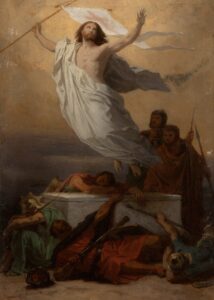
In fidelity to the most pure tradition of ancient Roman prayers, we remind God of the great marvel of His grace, the mystery we have been contemplating unceasingly over the past week: Through Christ, the Father has destroyed death. Through the death of the Son, death is no more. Death has lost its sting, because Christ accepted to die. In the very act of destroying death, our Blessed Lord opened for us the gates of eternal life, that life which was always with the Father, but from which we were barred due to sin. Through Our Lord’s death, the gates of death have been knocked down, and the path to unending life with God is opened. We now have an unobstructed, free path that leads straight to the place of repose.
But for this end, to walk consistently in that path, we need God’s grace. If the objective victory wrought by Christ on this day is to become subjective salvation for each one of us, the grace of God must animate us and help us, urging us on to ever greater progress in the ways of holiness. We have deep down in our hearts the desire for eternity, the desire for a life that will never end, a longing for eternal communion with love and life and with everyone who shares that same love and life. Everyone has those desires because God put them there when He created us. It is called the desire to see God, and it is in the heart of every human being. God alone could have put it there as a seed that is destined to grow, to put down deep roots and develop branches, leaves and fruit. It does so if it is watered by the rain of grace and is enlightened by the sun of divine truths. And this is why we ask God in the oration to follow up the desires of our hearts with His continual aid.
And so, on this feast of feasts, this solemnity of solemnities, let us give free rein to joy, that invincible joy of the saints who, in spite of whatever trials they were going through, kept their minds and hearts in the abode of the eternal kingdom where Christ does reign forever. For the soul who has come to know what this means, it does not matter what the cross of today is, for tomorrow is the day of eternity. For the soul that has come to love Christ with all its heart, the eternal abode is constantly drawing us to higher things, to getting out of self, to accomplishing the prodigies of grace that the eternal Risen One ever inspires us with.
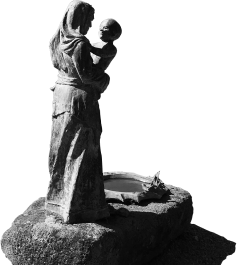
Mother Mary, Regina Coeli, understood all this on that first Easter morning when, at the crack of dawn, her Risen Son appeared to her, the first of all, and manifested to her His glory. May she hold us all in the folds of her mantle, and teach us, over and over again, the lessons that, as little children, we have a hard time learning. Life comes through death, victory comes through defeat. That is why the true Christian never gives up; the more we are put down, the deeper we plunge into the mystery of eternity. The drive of the true Christian never fades, just as true Christianity never dies, and the reason is obvious: alone of all men, our Lord found the way out of the grave.