
Maundy Thursday
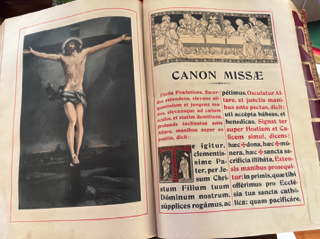
The first letter of the first word of the Canon of the Mass is a T. It didn’t take medieval Christians long to start seeing in that T a cross. Nor did it take artists long to start making that little T look like a cross, gradually adding the figure of Christ, then the Virgin and St John. It reached a point where the T needed its own page. That was the origin of the pious custom that became universal in the West, with the first page of the Canon preceded by a beautiful painting of the Crucifixion. It fixes the attention of the Celebrant in a marvellous way and reminds him of what he is doing at the Mass.
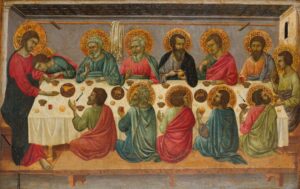
So what is he doing? He is fulfilling the command of Our Lord at the Last Supper: Do this in commemoration of me. But what is the ‘this’ that Our Lord commanded His priests to do? The Council of Trent gave the definitive answer to that question when it declared: ‘Because His priesthood was not to be extinguished by His death, in the Last Supper on the night in which He was betrayed, that He might leave to His own beloved Spouse the Church a visible sacrifice, such as the nature of man requires, whereby that bloody sacrifice, once to be accomplished on the cross, might be represented, and the memory thereof remain even unto the end of the world and its salutary virtue be applied to the remission of those sins which we daily commit, declaring Himself constituted a priest for ever, according to the order of Melchisedech, He offered up to God the Father His own Body and Blood under the species of bread and wine; and, under the appearances of those same things, He delivered His own Body and Blood to be received by His apostles, whom He then constituted priests of the New Testament; and by those words, Do this in commemoration of me, He commanded them and their successors in the priesthood, to offer them’ (Council of Trent, Session 22). There you have the explanation of what the priest does at Holy Mass and why it is fitting that he be reminded by the visible image of the crucifix as he enters the most sacred moment of the Holy Mass.
But there is another reason why it is good, not only for the priest, but for all the faithful, to see the image of the Crucified One at Holy Mass, and it is the reason for which the Church prescribes that the crucifix be visible above every altar. And this reason is connected with the mystery of the Church, the Mystical Body of Christ. Christ is the Head, we are the members. The members must follow the head under pain of no longer remaining in the body. At Baptism, each Christian is stamped in the image of Christ. He becomes an alter Christus, another Christ. As such, each one of us is called to realise in ourselves the mystery of Christ’s sacrifice.
In plain terms, that means when we come to Holy Mass, we come not only to receive, but, for the Mass to be complete, we must also come to give. In the Holy Mass, and especially in Holy Communion, Christ Our Lord gives Himself to us, but if we want that reception to achieve its full effects in us, then we must also give ourselves to Him; we too must become a Host, that is to say, a Victim, offered up for sins, our own and those of others.
Every Catholic knows that we must receive Our Lord in a state of grace, that is to say, without serious sin. But to receive Him profitably, it is not enough to receive Him in a state of grace; we must also receive Him in a state of sacrifice. This is why the priest signs you with the Sacred Host, making the sign of the cross over you, before placing the Host on your tongue. It is to bring home to you in a vivid manner that if you are in Christ, you no longer belong to yourself; you have the duty of sacrificing yourself.
A Communion well made supposes two Hosts: Jesus and you. This is why Jesus unites Himself to you. Not just to be your consolation in this land of exile, but to fortify you so that you, too, can become a Host offered up in sacrifice. Souls who truly understand the Holy Eucharist are consumed with ardour and feel the desire to cast off, not only all evil ego that hinders them, but as much as possible, they want to be wholly in Christ Jesus, in His passion, in His death.
Tonight, after we take Our Blessed Lord to the altar of repose, we will return to chant Vespers and then proceed to the striking ceremony of the stripping of the altar. The altar, which throughout the year is adorned with cloths and flowers, will appear to us naked, hard, in some way terrifying. The altar is the place of sacrifice. In the Old Testament, it is the place where the blood of lambs was poured in abundance. In the New Testament, it flows daily with the Blood of Christ, but that Blood is not complete until the blood of the members is united to that of the Head.
If we live around the altar, we must live in the atmosphere of sacrifice, and the reception of the Host will inspire our whole life with the spirit of the Host. We are all called to be a Host. A Host is first of all a grain of wheat that has to be ground and crushed. A Host is then a piece of bread which loses its own reality to become the Body of Christ. A Host is bread become Jesus Christ. The Host must be you; it must be me. We must become more and more like Christ.
To return to where we began, it took a while for those first T’s in the Missal to become ornate crucifixes. It takes some time for the Christian soul to understand what happened in its baptism when it was plunged into the death of Christ. It takes time to understand what it means to receive the Host. Some souls get there quicker than others, but we must all work towards that goal to become a Host in all that we do. From the most insignificant efforts of our daily routines to the great sufferings and humiliations of our lives, through it all, we must gradually become the victim offered up with Jesus for the salvation of the world.
When St Lucian, the old bishop of Nicomedia, was thrown into prison, the Christians, through bribery, managed to reach him. They said to the bishop: ‘Here is everything necessary for the Sacrifice; we must have Communion’. They had bread and wine, they had vestments, they had the prayers, but there was no altar! The saint then stretched himself out full length on his back on the ground, and with both hands free, celebrated the Mass on his own breast, which had now become the altar of sacrifice.
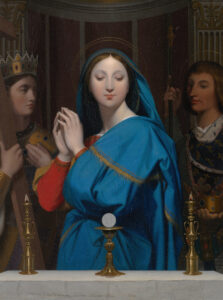
So it is with us. Our breast too must become an altar on which every pain, every hurt, every sorrow, every effort, is immolated in union with Jesus, with Jesus, for Jesus. When our blood mingles with that of Jesus, the Co-Redemptrix at the foot of the cross can then offer up the Victim, no longer two but one, to the glory of the Father.