
Quasimodo
If you have been to daily Mass during the octave of Easter, or even if you have read the texts of these Masses, you cannot fail to have noticed that, in addition to the events of the risen life of Our Lord and His apparitions to the apostles, as well as the preaching of this mystery to the first generation of Christians as it is presented in the book of Acts, there is another strand that runs through the Easter liturgy, and it is one which is destined to root us deeper in our faith and in our attachment to Christ. From the earliest ages, the Church began to set aside Easter as the principal time for receiving the sacrament of Baptism. The words of encouragement found throughout the Easter octave are destined for those who have recently been received into the fold.
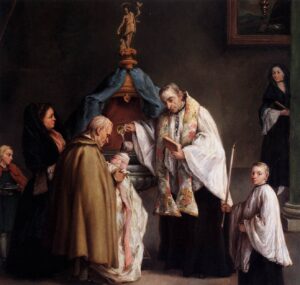
They do, however, concern all of us, as we are all called to remember that we too were once dead in our sins and have been brought to life by the laver of regeneration, that is to say, by the saving waters of Baptism. So what did Baptism do to us? First of all, it plunged us into the death and resurrection of Christ. This is why, in the early ages and still sometimes today, Baptism is performed by total immersion. One goes down into the waters to symbolise being buried with Christ in the heart of the earth, before rising up again, symbolising the resurrection to a new life, marked with the triple seal of the Holy Trinity. So what really happened on the day of our baptism? We received God’s grace, we received God’s life, and we were brought to life spiritually. Before then, we were dead, we had no grace, we had no life to speak of, we were destined to die and be forgotten, buried in hell. Baptism saved us from that; it gave us to be grafted onto the Holy Trinity, as it were, to have life in Him. It made us adopted children of God, truly part of His own family, heirs to eternal life.
St Peter, in a passage that was read at yesterday’s Mass, gives us this summary of the marvellous reality: You are a chosen race, a royal priesthood, a holy nation, God’s own people, that you may declare the wonderful deeds of Him who called you out of darkness into his marvellous light. Once you were no people but now you are God’s people; once you had not received mercy but now you have received mercy (1 Pt 2:9-10).
When you are part of God’s royal family, you have to behave in a certain way, and you must prove yourself worthy of such a privilege. You can no longer be a slave to sin. Furthermore, you have responsibilities vis-à-vis those who are not yet part of God’s family. Noblesse oblige. That duty of care requires that we be prepared to share with others the Good News of our faith so that they, too, may come to know Christ. But the capacity to do this is strictly dependent on our cultivating the gifts received. That is why St Peter also says: So put away all malice and all guile and insincerity and envy and all slander. Like newborn babes, long for the pure spiritual milk, that by it you may grow up to salvation; for you have tasted the kindness of the Lord… Like living stones be yourselves built into a spiritual house, to be a holy priesthood, to offer spiritual sacrifices acceptable to God through Jesus Christ (1 Pt 2:1-3).
The words ‘newborn babes’ were reflected in today’s introit, which begins with the word Quasimodo. There is no guile in a newborn babe. All it wants is the nourishment it receives from its mother’s breast. It is not capable of any mischievousness. The fact that St Peter thinks of when he wants to encourage the faithful is quite enlightening. We must be like newborn infants, leaving aside everything that could defile us in any way and longing only for the pure spiritual milk from the Lord. What is this milk? It is the Word of God; it is the sacraments; it is prayer. These should be the default position of every true Christian who has come to understand the privilege of being part of God’s family.
The problem with most of us is that we want to be ‘grownups’ and we lose this attitude of the infant in its mother’s arms, totally dependent and totally content. If only we could recover this frame of mind, and say in truth with St Paul: I count everything as loss because of the surpassing worth of knowing Christ Jesus my Lord. For his sake I have suffered the loss of all things, and count them as dung, in order that I may gain Christ (Ph 3:8).
St Augustine, in a homily pronounced on this day to the newly baptised Christians, gives them this sober warning: ‘Let us celebrate these holy days in such a way that the purity of our souls is not tarnished while we relax in body. But rather let us abstain from all luxury, uncleanness and drunkenness; in short, let our relaxation be sober, and in holy sincerity, so that whatever we have not yet acquired by bodily abstinence, we may seek to obtain by purity of mind’.
So, we have our program cut out for us. Perhaps it might be useful at this stage to be reminded about some of the thoughts that led us through Holy Week. First of all, we need to learn to become a Host. When we receive Holy Communion, there needs to be two Hosts: Jesus and us. The state of grace is essential to receive communion, but it is not enough. We also need the state of sacrifice, that attitude of one offered with Christ in His passion. With each Holy Communion, our desire to be configured to the image of the crucified one, to transform that T at the beginning of the Canon into a real crucifix, has to be constant. Little by little, we must become the Host that is offered up in sacrifice.
Secondly, we must accept to walk the path alone, that is to say, to not be shocked when there are few who actually listen to Our Lord and follow Him, not to be disheartened when those we thought we could count on walk away. Our Lord’s path to victory was in great solitude and isolation. In one of the prophecies we read during Holy Week, we could hear Our Lord speaking through the prophet Isaiah: I have trodden the wine press alone, and from the peoples no one was with me;…. I looked, but there was no one to help; I was appalled, but there was no one to uphold (Is 63:3,5).
Thirdly, we must have the patience to wait for God’s hour, and sometimes that hour does not seem to come. God sometimes intervenes to fix things when all seems lost; other times, He allows all to be lost in order to raise us to higher things than the ambitions of this life, even when they are good and noble.
In a homily on today’s Gospel, in which Our Blessed Lord says to the apostles: As my Father hath sent me, so do I send you, St Gregory comments: ‘The Father willed that His Son should come into the world to suffer; but yet He loved His Son, whom He sent to suffer. The Lord sends His chosen apostles, not to rejoice in the world, but to suffer in the world. Therefore, just as the Son is loved by the Father, and is yet sent to suffer; so likewise are the disciples loved by the Lord, and yet they are sent into the world to suffer. So it is rightly said, As my Father hath sent me, even so do I send you: that is, When I send you forth into all the terrors of persecution, I love you with that love with which my Father loved me, when He caused me to come into the world to undergo my Passion’.
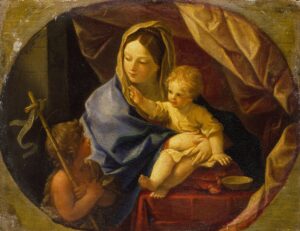
When the hour comes for each of us to weep and lament while the world rejoices, let us strive to be like the newborn babe, content to be in Mother Mary’s arms, longing only for the sweet milk of God’s grace. Let us remember that, as He Himself has said, there must come a time when His visible presence is no longer felt, and we must be in the dark. But one day, one day very soon, we will see Him again, and our hearts shall rejoice, and our joy no one will take from us.