
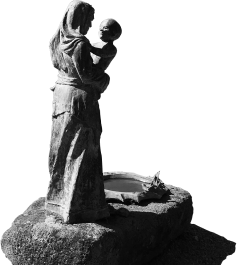
Good Shepherd
In today’s Gospel, Our Blessed Lord presents Himself to us as the Good Shepherd, the One who lays down His life for His sheep, the One who holds us in the palm of His hand, from which no one can snatch us away if we do not willingly reject Him. During Holy Week, we contemplated Our Lord laying down His life for His sheep, and we were given a bit of insight into what He meant when He said: No one takes my life from me; I lay it down of myself (Jn 10:18). He lays it down willingly. He loved us to the end (Jn 13:1).
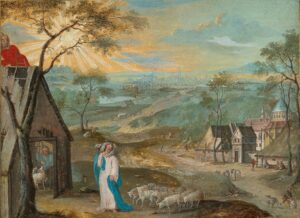
After Easter, on the days during the octave, each day the Gospel gave us a different glimpse into the truth of what St Ignatius tells us when He says that when contemplating the mysteries of the Resurrection, we should ‘consider the office of consoler that Christ Our Lord exercises, and compare it with the way in which friends are wont to console each other’ (Sp. Ex. # 224). I propose to return to one of those apparitions that highlight how the Good Shepherd does not forget His friends, but gathers them together as a shepherd gathers His scattered sheep, and teaches them profound lessons about the spiritual life.
St John is the only evangelist to tell us of the apparition to the disciples on Lake Tiberias (Jn ch. 21). He does not tell us exactly when it took place, but it was sometime between Easter and the Ascension. The presence of the glorified Jesus after the Resurrection was not like His presence before the Passion. He did not stay permanently, but only showed Himself on certain occasions. This, of itself, is a lesson. The manifest visits of God in this life are not constant. He makes His presence felt only at certain moments, enough to keep us going, but reserves the full gift of Himself to eternity. This does not mean that He is not always present, but that He does not always manifest His presence.
It was during one of the periods when the Lord was away that the disciples, under Peter’s leadership, decided to go fishing. They had no longer any means of survival since the death of Our Lord, and so they were hungry. They were also desirous of keeping themselves busy, and they did so in a good, healthy way. They take a boat out onto the lake, and they spend the night casting their nets, which is usually a really good way of getting plenty of fish. Unfortunately, however, this particular night they caught nothing.
In the morning, the seven men are exhausted and discouraged. They feel so lost without Jesus. If only He would come. A man appears on the shore and shouts out to them, asking if they have any catch of fish. The question touched a very sensitive spot. By trade, these men were fishermen, and they should have caught at least something. The answer is humbling. Fortunately, it is not for nothing that they have just spent three years in formation with the Son of God Himself. They speak the simple truth, they acknowledge their need, they admit their poverty. Their reply is a simple No. No excuses, no trying to hide the truth, nothing to save face. It’s just the simple, unadulterated, bare, humiliating truth: No.
It’s amazing how such a forthright answer can open up an ocean of blessings. Let’s keep this in mind. When God comes into our lives, He does not expect us to come with our hands full of gifts for Him. He doesn’t need anything from us. The only thing He asks for is that we acknowledge the truth, and the most fundamental truth is that we have nothing of ourselves. Not a bit, nothing at all. The simplest answer is the best, no excuses, no justification, no attempt to divert attention from what hurts. And that’s all the Lord needs: that we admit we need Him, and then He acts.
His intervention, however, is made dependent not only on the act of humility that recognises their need, but it is also dependent on an act of obedience to a command that tells them to do something that seems ridiculous. Cast the net on the right side of the boat, and you will find some. Really? Is that plausible? Like the fish can’t go around the boat, when they are swimming all the time, all around the lake? The apostles, however, as we have said, did learn a few things in their seminary time with Jesus. They learned to obey, not just Jesus, but they learned to have a spirit, an attitude of obedience to anyone. At this stage, they do not know that the man is Jesus, but they obey anyway. The Gospel simply says that on hearing those words, so they cast it. They obeyed. Instantaneously, the net fills with fish, so much so that now they were not able to haul it in, for the quantity of fish. The reward for their obedience brooks no delay. St Benedict tells his monks that their obedience to commands should be immediate: as soon as the command is given, they should execute it. But the reward is often immediate as well, and in this case, it is visible. For two simple acts of humility and obedience, what their own labour for a whole night had failed to produce, comes about in a moment.
At this stage, it doesn’t take the disciples long to figure out who this man is. It’s John, the beloved disciple, the virgin disciple, who is the first to realise the unexpected truth: It is the Lord! At which Simon Peter jumps into the sea to swim to shore and be the first to be with the Master. The other disciples bring the boat in, and the fish are counted: 153 big, healthy fish. Unlike the first miraculous catch at the beginning of the apostolic ministry of Our Lord (cf. Lk ch. 5), which symbolised the catch of fish into the Church, containing good and bad, this catch symbolises only the good who will actually make it to Heaven. This is why Our Lord is standing on the shore, whereas before He was on the boat. Now the Lord is forever beyond the sufferings and vicissitudes of the roaring sea of this life. He is ever stable in His eternal glory, but He is nevertheless ever present to the needs of His sheep. I know mine and mine know me.
The great lesson I would like for us to remember today is this: the night during which the apostles catch nothing stands for those long periods of darkness that we all go through during which we do not seem to be getting anywhere, but in reality the Lord, the Good Shepherd is keeping watch, and He will make His presence felt at a moment He has determined. But for His grace to produce its fruit, we must always remain before Him empty-handed. Like the apostles, we must simply admit our need, our emptiness, our nakedness, our utter poverty before Him. He likes this because it is the truth.
The great problem is that few people actually have this mentality. They want to do, to achieve, to come to the Lord with the work of human hands as if He needed it, much like the Pharisee in Lk ch. 18. In a letter to a community of Carmelites, St John of the Cross speaks of people who ‘do not stay empty, so that God might fill them with His ineffable delight; so they leave God just as they came – their hands were already full, and they could not take what God was giving. God save us from such unhappy burdens which keep us from such fair and wholesome freedom!’
To return to the Good Shepherd, it’s also St Luke (Lk ch. 15) who tells us that the Good Shepherd leaves the ninety-nine in order to go after the one who is lost. We are all lost at some stage, and you can be sure that the Good Shepherd is running after us. What is absolutely essential, if we wish to be saved, if we wish to make progress in the spiritual life, is that we have the humility to allow Him to take us on His sacred shoulders. We must not think and act as if we could straighten ourselves out. If we do that, we will remain alone, and the wolf will devour us.
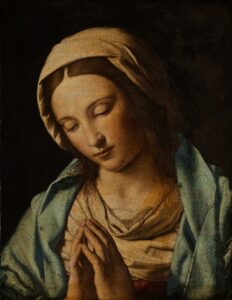
May the Mother of the Good Shepherd teach us how to be good sheep, how to persevere in the dark nights of our lives, and to never doubt the presence of the Lord even when we don’t feel it. May she obtain for us the grace to acknowledge our emptiness so that we can be filled with all the fullness of her Divine Son, the eternal Shepherd of our souls.