
Third Sunday of Lent
There was a time when it was fashionable for certain intellectuals to launch against Christianity the scornful epithet of being a woman’s religion, a religion without guts. Frederich Nietzsche, in particular, made it one of his great battle cries, pretending that modern man has finally been freed from the wives’ tales of medieval times and is now able to stand on his own two feet. You will still find those today who accuse our religion of being one for weaklings, for those who cannot face the world and its realities, who do not have the strength to compete and win, who cop out and imagine some fairy land in which all the troubles of this world will be gone.
On the contrary, if there is one thing that today’s liturgy proves to us, it is that Christianity is no religion for wimps. Or rather, that the soul that embraces Christianity wholeheartedly is meant to be gradually transformed from the inside into a strong spiritual citadel, a force the world has to contend with, and before whom it is powerless. The grace of fortitude, of power, of endurance, seems to be instilled at every turn, from the words of Our Lord in the Gospel to the expressions of St Paul to the Ephesians and the orations and even the assertive melodies that give us to stand firmly and squarely in the truth and in the confidence of ultimate victory.
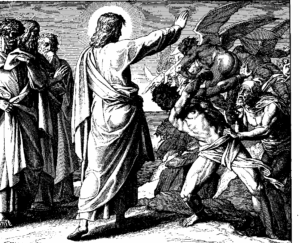
In the Gospel, our Blessed Lord had just expelled a devil that had taken from his victim the capacity to speak. The man’s tongue was unleashed, he began to speak, and the crowds were ecstatic. The smart alec Pharisees, of course, have the retort: this man casts out devils with the power of the devil himself. What a stupendous finding! Even a child would have seen straight through it. The Lord takes this occasion to give a salutary warning to its inventors, and thereby to all of us. If you deny the obvious, you are messing with the devil. And if you mess with the devil, you will get burned. And so beware. You do not want to be with the devil.
The devil has power, but his power is exercised only over those who hand themselves over to his wiles. That was the whole point of the First Sunday in Lent, when we saw Our Blessed Lord endure temptation, to show us how to resist. Baptism frees us from the clutches of Satan. To fall back under his power after having been redeemed by Christ is a misfortune of catastrophic proportions, for then it would be to abandon the One who is Fortitude incarnate, and throw oneself into the lion’s mouth. Ever since the Incarnation of Our Lord, the devil has had a chain around his neck. You get bitten only if you go too close. Only a fool gets bitten by a dog on a chain. Beware, lest one devil, having been cast out, seven others, more wicked than the first, enter. And the last state becomes worse than the first.
The great lesson offered to us by the mention of the seven worst devils is that we must be very careful to preserve and nourish the grace of our conversion. When God offers a soul the grace of turning back to Him, He gives that soul special insight into its failings and light as to what it must do in the future in order to remain faithful to God. To offend against that grace, to turn one’s back on the specific grace of one’s conversion, to play loose with God as if He were just one god among others, is to open oneself up to much worse than before.
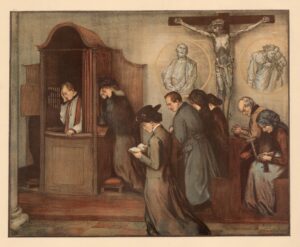
It happens that a soul goes away from a sermon or a confession or a retreat, with doubts and difficulties resolved, intent on living a truly Christian life. It is like a dark veil that has separated him from God has been torn away. It is like the veil of the temple that was rent from top to bottom at the time of the death of Our Lord (cf. Mt 27:51). (If you have read Brideshead Revisited, you may recall how Evelyn Waugh so astutely uses this verse to convey the conversion of Julia Flyte). Such wonderful, divine peace then envelopes the soul. Everything is clear, but with more light comes more responsibility. If that soul falls back, he may very well plunge into even greater spiritual darkness than before, and his last state becomes worse than the first. If one keeps falling back into sin, one runs the risk of hardening one’s heart. The sharp sting of conscience, the remorse, the shame, the wretchedness of soul that used to come after sin can begin to fade. Divine grace does not penetrate with its accustomed depth. St Paul tells us just a few verses before the passage in today’s epistle: Grieve not the holy Spirit of God (Eph 4:30). Do not sadden God by turning back, by losing the grace that He has won for you by means of His painful death on the cross. Be not, according to the expression of St Peter, like the dog returned to his vomit or the washed sow wallowing in the mire (2 Pt 2:22).
He who is not with me is against me, and he who does not gather with me scatters (Mt 12:30). It is so easy to be strong and persevering in the good. All that is required is to stay close to Jesus, to stand with Him, for when you do so, you enjoy His eternal, divine might. But if you fail to take a stand with Him, then you find yourself not only without Him, but you find yourself against Him. Why is that? It is not I but God Himself in the flesh who tells us: He who is not with me is against me, and he who does not gather with me scatters. It’s so very easy, and it’s so very simple. Is it so surprising that when God steps into our world, showing such incredible mercy and love that He put on our mortality so that He could die to save us, is it at all surprising that from that time on, it is not possible to be indifferent to Jesus Christ?
Today’s Gospel concludes with the well-known passage in which this woman from the crowd blesses the Mother of Jesus. Blessed is the womb that bore thee, and the paps that gave thee suck. His reply: Blessed are they who hear the word of God and keep it (Lk 11:28) is a salutary reminder to us all that we have in Holy Scripture and in the Tradition of the Church the means of knowing His will for us and living in accordance with it. God has left nothing to chance. All has been provided for. Who is there among you that feareth the Lord, that heareth the voice of His Servant, that hath walked in darkness, and hath no light? let him hope in the name of the Lord, and lean upon his God (Is 50:10).
And so, as we pursue our Lenten exercises, let us renew our devotion to the prayerful reading of Holy Scripture with faith and humility. Our Holy Father St Benedict, whose death we commemorate at the end of next week, tells us at the end of the Rule that each page, each word even, of Holy Scripture is a sure guide to living a truly Christian life. And St Gertrude, the great Benedictine nun, tells us that love for the Sacred Scriptures is a sure sign of chastity. Let us, then, turn to that Word with renewed devotion. If we do so perseveringly, then we will fulfil the apostle’s command to avoid the contaminations of the world and the flesh: You were heretofore darkness, but now light in the Lord. Walk then as children of the light (Eph 5:8).